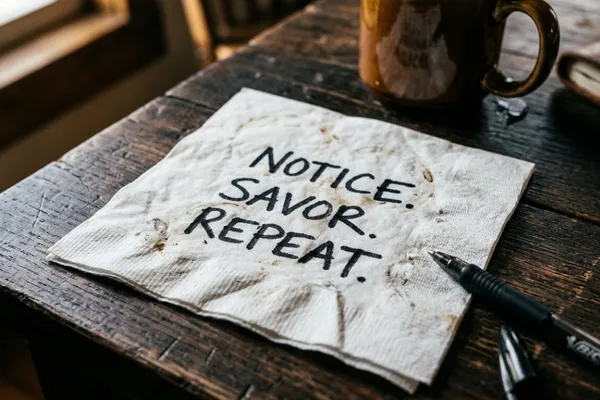
The 3-Minute Gratitude Habit That Rewires Your Brain

The 3-Minute Gratitude Habit That Rewires Your Brain (Backed by Science)
Three research-backed gratitude tools—an unsent letter, a night journal, and a text chain—that rewire your brain, lower stress, and fight back against negativity.
Spotlight Saturday
By Brett G Waddell ~ TheMorningMotivator.com
Don't miss tomorrow's Strategic Sunday Upgrade — The Science of Gratitude: How a 5-Minute Practice Can Rewire Your Brain for Success — free at 4:44 AM. Subscribe →
WAKE UP! Awareness Brings Answers!
You know that moment when your eyes open and before your feet even hit the floor, your brain is already running the highlight reel of everything that's wrong? The email you didn't send. The conversation you're dreading. The headlines you shouldn't have read before bed. The "why wasn't I invited?" expanding that awful negative loop?
I had one of those mornings today—at 12:34 AM. It was one tiny thought that I kept feeding until it pissed me off enough to get out of bed. I was scrolling YouTube before I was even fully awake. Sound familiar? Here's what messed with me: I couldn't tell you one good thing that happened the day before. My brain was so busy scanning for threats and feeding the story about the event I wasn't invited to that it completely missed everything worth noticing.
And that's not a character flaw—that's what your brain does when you let the world outside dictate what gets your attention. Negative experiences become sticky. Gratitude slides right off.
But here's what I've learned: if you don't take control of what your mind focuses on, the world will do it for you. And the cost isn't just a bad morning—it's your health, your relationships, your ability to actually feel like your life is yours. The research on this is wild—changes to your stress response, your sleep, even your heart rate variability.
So today, I'm bringing in someone who's cracked the code—Mel Robbins—with three research-backed tools that take less time than your morning coffee. And I'm grateful you're here, because this one's personal—I need this reminder as much as you do.
But here's what I need you to sit with before we dive in: if gratitude is an act of defiance against a world that wants you negative... what's been winning in your head lately?
🏆 Spotlight Saturday UPGRADE
Most people wait for a good day before they feel grateful. Mel Robbins did the opposite—she treated gratitude as a fight-back mechanism, not a mood. Here's the real issue: your brain is scanning for threats by default, and negative experiences stick like Velcro while gratitude slides right off.
🎖️ The Upgrade: Tonight, before your head hits the pillow, write down three small things from today you're grateful for—specific, not generic.
(Full REAP breakdown and theta application below 👇) That's not just a journal prompt. That's how you stop the day from erasing the good. Awareness, as always, brings answers. Here's the breakdown.
"Gratitude is an act of defiance in a world that's trying to gaslight you into thinking you have no power. What you focus on will expand."
Don't have time for the full podcast? I already pulled the exact moments that matter below. Hit play if you want to see it live, or keep scrolling for the breakdown.
Seeing it makes it real. Now, let's extract the exact mechanics so you can apply this to your life today. Keep reading for the core concepts, the 5-minute audit, and the REAP framework to wire this in for good.
🌞 The Core Concept: Gratitude as Cognitive Reframing
This isn't about pretending the hard stuff isn't happening. It's about training your brain to choose what it notices—because what you focus on expands.

🟢 The Velcro/Teflon Principle — Why This Works
Under stress, negative experiences become sticky in the brain like Velcro—you hold onto them because your brain is in survival mode.
As Dr. Rick Hanson explains, your brain is built to hang onto threats for self-preservation. Gratitude is the Teflon. It doesn't erase the hard stuff; it makes it slide off. Dr. Aditi Nerukar puts it plainly: gratitude journaling is cognitive reframing—a fancy scientific name for "what you focus on grows."
Even if good and bad are happening at the same rate, stress makes you see only the bad. Gratitude is how you shift what your brain scans for, and it takes as little as 60 seconds to start.
Key Takeaways:
Negative experiences stick like Velcro under stress—that's biology, not a character flaw.
Gratitude is cognitive reframing: what you focus on grows.
The fix is a deliberate shift in what you notice, not a denial of what's hard.
🟡 Tool #1 — The Unsent Letter
Once a week, write a one-page letter to someone you're grateful for. You don't have to send it—the writing itself changes you. Be specific: What did they do? Why did it matter? How did it affect you?
In an Indiana University randomized controlled trial led by psychologist Dr. Joel Wong, nearly 300 people in therapy were split into three groups: therapy only, expressive journaling about stress, and one gratitude letter per week.
The gratitude group showed significantly better mental health—reductions in depression and anxiety—not just during the four-week writing period, but twelve weeks later.
Key Takeaways:
One letter per week. One page. One person.
Specificity is the mechanism: the action, the meaning, the effect on you.
The effect has an afterburner—benefits persisted 12 weeks out.
🟠 Tool #2 — The 3-Minute Night Journal
Keep a notebook by your bed. Every night, write down three small things from the day you're grateful for. Not deep philosophy—the parking spot, the cup of tea, the laugh with your kid.
In a study led by Dr. Laura Redwine at the University of California, San Diego, 70 participants with early-stage heart failure were split into a gratitude journaling group and a standard-care control. Over eight weeks, the journaling group showed lower stress, reduced inflammation, higher heart rate variability (a marker of resilience), and better sleep quality.
No notebook? Dr. Daniel Amen's version—the What-Went-Well Scan—works just as well: lie there and ask, "What went well today?"
Key Takeaways:
Three minutes, three small things, every night.
Measured physical benefits: stress, inflammation, HRV, sleep quality.
Small and specific beats profound and vague.

🔵 Tool #3 — The Gratitude Group Text
Drop gratitude into your existing text chains and interrupt the transactional flow. A study led by Dr. Shelley Kerr at Griffith University's School of Applied Psychology followed 122 people waiting to get into therapy—a high-distress group. Split into gratitude, kindness, and control groups, the gratitude group reported less depression and more positive emotions after two weeks—and the effects were still present a month later.
The gratitude group slightly outperformed the kindness group, and both beat the control!
The emotional and reflective aspect is what drives the effect. Mel noticed her own text threads with her executive producer had become pure logistics—so she started dropping in real appreciation.
It spread, and her company now runs a "Personal Victories and Celebrations" channel.
Key Takeaways:
Sprinkle one genuine gratitude text into a chain once a day.
Reflective gratitude beat general kindness in the measured outcomes.
Positivity is contagious—it can become the sticky thing.
Bonus from neuroscientist Dr. Tara Swart—the Morning Doorway: before your brain "kicks in," go straight to gratitude. Snuggle into your pillow and appreciate the sheets, the mattress, the quiet, the warmth of your tea. Same science, same benefit, different doorway.
🔴 The Afterburner Effect — This Isn't a Quick High
In the Indiana University letter study, the improvements in depression and anxiety didn't fade—they were still there twelve weeks after the writing stopped.
The Griffith University text-chain study found the same thing: measurable mood benefits still present a month later.
Mel calls it an afterburner effect. The shift sticks—because you've trained your brain to scan for what's good, not just what's threatening.
Key Takeaways:
The letter study's benefits held 12 weeks after writing stopped.
The text study's benefits held a month later.
This is a training effect, not a mood spike.
⚪ The Pick One Rule — How to Actually Start
You don't need all three. Mel is blunt about this: she doesn't want you to do more—she wants to give you options.
The best tool is the one you'll actually use!
One letter, three lines in a journal, or one gratitude text. That's the whole ask. Start with one. Stack the reps.
Key Takeaways:
Pick the one that fits your life, not the one that sounds most impressive.
Consistency beats intensity—the tool you do is the tool that works.
Don't do more. Do one, and do it consistently.

❓ Quick Reality Check (Before We Begin)
🔸 You might be thinking: "Isn't this just toxic positivity? Bad things are actually happening."
The Truth: No one is denying the hard stuff. Gratitude isn't pretending problems away—it's cognitive reframing. Negative experiences become sticky under stress because your brain is in survival mode. Gratitude is the deliberate counterweight.
Mel is explicit: this is not toxic positivity. It's intentionally programming your mind and protecting yourself from the onslaught of negativity.
🔸 "Do I have to do all three tools? That sounds like a lot."
The Truth: No. Pick one. Mel says it plainly—she doesn't want you to do more, she wants to give you options. The best tool is the one you'll actually use. One letter, three lines in a journal, or one gratitude text. That's the whole ask.
🚀 The REAP 5-Minute Reset & Rewire
This is how we think. This is how we move. This is how we show up! This is why I built REAP—because knowing the science means nothing until it runs through your hands.
Don't just read this—run one full round right now:
R — Recognize & Run Out (Minutes 1 & 2)
Name the loop. What's the one story you've been feeding—the event you weren't invited to, the email you're dreading, the conversation you're replaying? Fact-check it honestly: has feeding that story once ever made you feel better? Pause the old narrative.
E — Exchange + Envision + Emotion (Minutes 3 & 4)
Exchange the input. Picture tonight: notebook by the bed, three small things from today. See yourself writing them—the parking spot, the tea, the laugh. Feel the shift from scanning for threats to noticing what's actually okay.
A — Activate with Action (Minute 5)
Write down the one tool you'll run this week—the letter, the journal, or the text. Name the person or the chain. Commit before the day ends.
P — Program & Prosper (The Theta Window)
Celebrate tiny wins and lock this in during your neurological goldmine: the first 5–10 minutes after waking, or the last 5–10 before sleep. Stack the reps. Presence becomes identity. Identity becomes reality!
(Note on the science: This is the foundation of Hebbian learning—"neurons that fire together, wire together." Repeated mental patterns physically strengthen neural pathways, a principle first established by Donald Hebb in 1949 and continuously validated in modern neuroplasticity research.)

🧠 Lock It In Before the Loop Wins Again!
If this reset shifted something for you, don't let it fade by noon!
Get tomorrow's Strategic Sunday Upgrade — The Science of Gratitude: How a 5-Minute Practice Can Rewire Your Brain for Success — dropping free at 4:44 AM.
Subscribe Free → and get instant access to the 2-Page REAP & Theta Mornings PDF
🎖️ Spotlight Saturday Upgrade: Tonight, before your head hits the pillow, write down three small things from today you're grateful for—specific, not generic.
Five minutes. One shift. One upgrade. Stay focused. Keep building!
P.S. — This is how we reach the perfect day. Not all at once. One deposit at a time. One honest pattern at a time. One upgraded morning at a time. See you tomorrow at 4:44 AM.
🌱 Start Here: The Foundation
🔸 Your Genes Are the Blueprint, Your Beliefs Are the Builder: Rewiring Reality Through Epigenetics
The foundation of our biology teaching: how beliefs, environment, and repeated inputs shape the way we live. CLICK HERE →
🔸 The Illusion of Reality: Where Consciousness Research Meets Direct Experience
The beginning of our consciousness and awakening series—an invitation to question the reality you have been handed. CLICK HERE →
💖 This post exists because I believe the best thing I can do for you is bring you the truth — Scientific, Soulful, and Actionable. YOU are why I'm here — so my mistakes and research become your shortcuts!
Pay It Forward! 🚀
~Brett
TheMorningMotivator.com
We're Upgrading 1%+ Every Day! (+34% Monthly, +38% Annually!)
Medical & Training Disclaimer: Hey, I'm just your science-backed, soul-led, unapologetically human mindset & performance trainer. The content provided in this blog post is for educational and informational purposes only. I am not a licensed physician, physical therapist, or medical professional, and this blog is NOT intended as a substitute for qualified medical advice. Always consult your healthcare provider or certified coach before making major life decisions or life changes. Got it? Good. I'll catch you tomorrow. Peace out!


