
The 72-Hour Rule: Build Muscle with Only 2 Days a Week

The 72-Hour Rule: How to Build Muscle With Only 2 Days a Week
Muscle grows when you apply tension every 72 hours. Use a full-body plan for 2-day weeks and progress by adding reps or sets.
Fitness Friday
By Brett G Waddell ~ TheMorningMotivator.com
Don't miss tomorrow's Spotlight Saturday Upgrade: The More You Study Consciousness, the Weirder It Gets: Michael Pollan on the Thoughts You Never Chose — free at 4:44 AM. Subscribe →
WAKE UP! Awareness Brings Answers!
I was probably 12 or 13 when I first got the bug. I can't tell you the exact moment, but I'm pretty sure Arnold Schwarzenegger had something to do with it.
I didn't have any weights, so I started running. Then I got a set of weights for Christmas, and I'd spend hours doing curls in front of the TV during commercial breaks. I thought I was doing it right.
Then my Uncle Bobby saw me and set me straight. He said, "You need to learn how to do it right. Grab yourself a muscle magazine." I took his advice and never looked back.
I fell in love with the sport! Serge Nubret, Frank Zane, Franco Columbu, Lou Ferrigno, Mike Mentzer—and obviously Arnold. The list goes on. The point is, I didn't know what I was doing. I was just over-the-top inspired. But that inspiration stuck.
I'm still lifting today at 60 years old. And Uncle Bobby gave me more than just that first tip. He gave me one I've never forgotten, and I hope it sticks with you too:
"If you want big arms, you need to work your triceps. Your triceps are bigger than your biceps. Biceps have two heads, triceps have three. Don't forget your triceps." Thanks, Uncle Bobby!
If you're just getting started with weights, or if you've been lifting for years, it's always good to know what the current science says. Fitness for life—that's the way to go. Physical fitness prevents and relieves so many problems. Today, we're breaking down the science with Dr. Andy Galpin so you can stop guessing and start growing!
Everything is broken down piece by piece, so you can pull out exactly what you need. Quick read now. Quick reference later. Let's get into it.
🏆 Fitness Friday UPGRADE
Most people train a muscle once a week and wonder why it's not growing. Dr. Galpin's research shows the opposite approach works better. Here's the real problem: you're not hitting the muscle often enough.
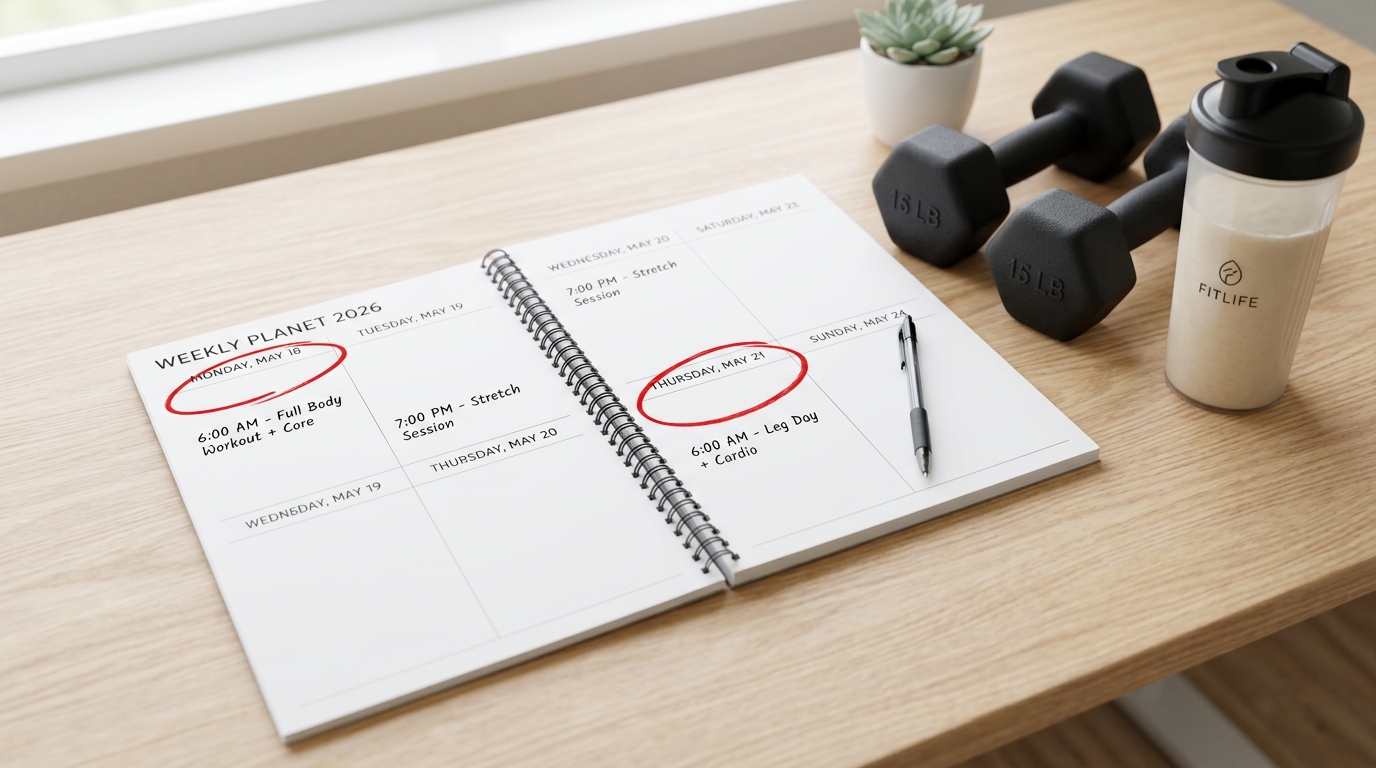
🎖️ The Upgrade: Pick two full-body workout days (like Monday and Thursday) and hit every major muscle group both days. That's it. That's the 72-hour rule in action.
(Full REAP breakdown and theta application below 👇)
That's not just a workout schedule. That's how you finally see the growth you've been earning. Awareness, as always, brings answers. Here's the breakdown.
"The single largest reason for [a plateau] is they don't have any sort of structured progressive overload. Even if that plan is not great, when you have a plan in place, you will see more results. Period."
Don't have time for the full podcast? I already pulled the exact moments that matter below. Hit play if you want to see it live, or keep scrolling for the breakdown.
Seeing it makes it real. Now, let's extract the exact mechanics so you can apply this to your life today. Keep reading for the core concepts, the 5-minute audit, and the REAP framework to wire this in for good.
🌞 The Core Concept: The 72-Hour Rule and Progressive Overload
Dr. Andy Galpin has spent his career studying human performance. In this breakdown, he simplifies muscle growth into two non-negotiable principles: mechanical tension every 72 hours, and structured progressive overload.
Master these two things, and you'll build muscle even on a busy schedule!
🟢 The 72-Hour Rule: Frequency Beats Everything
Muscle growth is driven by what's called mechanical tension. In plain English: you need to put some sort of load on the muscle, and you need to do it often. Dr. Galpin dumbs this down to what he calls the 72-hour rule. Every 72 hours or so, try to put a stimulus on the muscle you want to grow.
This is the foundation. Right now, some training protocols will break that rule, but Dr. Galpin says to learn the rules first before worrying about the exceptions.
How you hit that 72-hour window is up to you. If you're in the gym five or six days a week, you could do a body part split—arms one day, back another, quads another. If you only have two days a week, you'd use a full-body routine so that every muscle gets some mechanical tension every 72 hours.
Key Takeaways:
Mechanical tension is the primary driver of muscle growth
Apply tension to each muscle group roughly every 72 hours
2 days a week? Full-body routine. 5-6 days? Body part split.
🟡 Heavy or Light? The Science Says Both Work
Here's where most people get stuck. They think there's one magic rep range. Dr. Galpin says the research is clear: it's not about the repetitions per set. It's about the underlying physiological principle—mechanical tension.
You can go heavy, as low as five repetitions per set. Or you can go light with up to 30 repetitions per set. There's excellent research showing even up to 30 reps can give you equal muscle growth as five to six reps. What matters is that you're creating that tension!
Equipment doesn't matter either. Barbells, dumbbells, bodyweight, bands, machines, kettlebells—all of it is fine. They're just different ways to put tension on the tissue. Pick what you have access to and what you'll actually do.
Key Takeaways:
Rep range doesn't matter as much as reaching close to failure
5 reps or 30 reps can produce equal growth
Any equipment works—just apply tension
🔴 Train Close to Failure (But Not Always to Failure)
One consistent theme across all effective programs: you have to try hard. Dr. Galpin says as long as you reach pretty close to failure, you're fine. More recent research indicates you don't have to go all the way to failure.
Most people should aim for within one to three repetitions to failure, at least by your last set. If you feel like you could have got one more rep done but that's it, you're probably in a good spot. If you feel like you could have done five or six or eight more reps, that's probably not enough tension to drive significant hypertrophy.
This is where honesty matters. Most of us stop when it gets uncomfortable, not when we're actually close to failure. That's the difference between maintenance and growth.
Key Takeaways:
Aim for 1-3 reps shy of failure on your last set
Stopping with 5-8 reps left won't drive growth
Effort is non-negotiable
🔵 Progressive Overload: The #1 Missing Piece
Dr. Galpin says the single largest reason people plateau is they don't have any structured progressive overload. This is where you'll see a significant difference between making up your workouts as you go and having a plan.
Progressive overload means some sort of increased stimuli. The easiest to describe is adding weight—but that's honestly not super realistic. It only lasts four or five weeks before you can't keep adding load.
More common and realistic methods:
Add a few more repetitions per set (8 reps becomes 9, then 10)
Add more sets (2 sets becomes 3)
Increase range of motion
Increase frequency (train that muscle 3x/week instead of 2x)
A combination of the above
You don't have to progress every single week. Every two or three weeks is still fine and more realistic. The point is to have a plan and track it. Even if that plan is not great, when you have a plan in place, you will see more results. Period.
Key Takeaways:
Progressive overload is the #1 missing piece for most people
Add reps, sets, frequency, or range of motion—not just weight
A simple plan beats no plan every time

❓ Quick Reality Check (Before We Begin)
🔸 You might be thinking: "But I've always been told 8-12 reps is the only way to build muscle. Isn't this just another fitness fad?"
The Truth: No one is denying that the 8-12 range works. The shift isn't about throwing out the old; it's about expanding your toolkit. You can hold both truths: The 8-12 range builds muscle, and so do 5-6 or 20-30 reps when taken close to failure.
The science supports flexibility, not rigid dogma.
🔸 "Does this mean I have to spend hours in the gym doing endless sets to see results?"
The Truth: No. The mechanism is about quality of tension, not just quantity of volume. Research shows gains taper off significantly after a certain number of sets per muscle group per week.
The fix isn't doing more; it's doing the right work with real intensity and then letting your body recover.
🚀 The REAP 5-Minute Accountability Reset
This is how we think. This is how we move. This is how we show up! Don't just read this—run one full round right now:
R — Recognize & Run Out (Minutes 1 & 2)
Name one muscle group you've been training only once a week and wondering why it's not growing. Fact-check it honestly: has that frequency actually built the muscle you want, or just given you a false sense of doing enough? Pause the old "once a week is fine" story.
E — Exchange + Envision + Emotion (Minutes 3 & 4)
Exchange your input. Visualize your next workout. Instead of your usual routine, see yourself hitting every major muscle group in one session—squats, presses, rows, curls, triceps work. Feel the shift from "I don't have time for more gym days" to "I can build muscle in just two days a week."
A — Activate with Action (Minute 5)
Write down your two full-body workout days for this week. Monday and Thursday? Tuesday and Saturday? Commit to it before the day ends.
P — Program & Prosper (The Theta Window)
Celebrate tiny wins and lock this in during your neurological goldmine: the first 5–10 minutes after waking, or the last 5–10 before sleep. Stack the reps. Presence becomes identity. Identity becomes reality!
(Note on the science: This is the foundation of Hebbian learning—often summarized as "neurons that fire together, wire together." Repeated mental patterns physically strengthen neural pathways, a principle first established by Donald Hebb in 1949 and continuously validated in modern neuroplasticity research).

🧠 LOCK IN Your 72-Hour Schedule Before Your Next Workout!
If this reset shifted something for you, don't let it fade by noon!
Get tomorrow's Spotlight Saturday Upgrade — The More You Study Consciousness, the Weirder It Gets: Michael Pollan on the Thoughts You Never Chose — dropping free at 4:44 AM.
Subscribe Free → and get instant access to the 2-Page REAP & Theta Mornings PDF
🎖️ Fitness Friday Upgrade: Pick two full-body workout days (like Monday and Thursday) and hit every major muscle group both days. That's it. That's the 72-hour rule in action.
Five minutes. One shift. One upgrade. Stay focused. Keep building!
P.S. — This is how we reach the perfect day. Not all at once. One deposit at a time. One honest pattern at a time. One upgraded morning at a time. See you tomorrow at 4:44 AM.
🌱 Start Here: The Foundation
🔸 Your Genes Are the Blueprint, Your Beliefs Are the Builder: Rewiring Reality Through Epigenetics
The foundation of our biology teaching: how beliefs, environment, and repeated inputs shape the way we live. CLICK HERE →
🔸 The Illusion of Reality: Where Consciousness Research Meets Direct Experience
The beginning of our consciousness and awakening series—an invitation to question the reality you have been handed. CLICK HERE →
💖 This post exists because I believe the best thing I can do for you is bring you the truth — Scientific, Soulful, and Actionable. YOU are why I'm here—so my mistakes and research become your shortcuts!
Pay It Forward! 🚀
~Brett
TheMorningMotivator.com
We're Upgrading 1%+ Every Day! (+34% Monthly, +38% Annually!)
Medical & Training Disclaimer: Hey, I'm just your science-backed, soul-led, unapologetically human mindset & performance trainer. The content provided in this blog post is for educational and informational purposes only. I am not a licensed physician, physical therapist, or medical professional, and this blog is NOT intended as a substitute for qualified medical advice. Always consult your healthcare provider or certified coach before making major life decisions or life changes. Got it? Good. I'll catch you tomorrow. Peace out!


