
Cardio After Lifting: 4 Variables That Make or Break Gains

Cardio After Lifting: The 4 Variables That Determine If You're Building Muscle or Wasting Time
Fitness Friday
By Brett G Waddell ~ TheMorningMotivator.com
WAKE UP! Awareness Brings Answers!
Great Morning!
Today's topic was my common practice for decades—until about 7 years ago when I found out the scientific truth.
For years, I'd finish my leg workout, feel that deep burn in my quads, and immediately hop on the StairMaster or treadmill for 45 minutes of "fat-burning cardio." I thought I was optimizing.
Turns out, I was leaving half my potential gains on the table.👀
Here's the reality: combining resistance training and cardio in the same session is common practice—whether for fat loss, heart health, or general conditioning. But a critical question keeps popping up in the muscle-building community:
Does doing cardio immediately after weight training interfere with muscle growth?
The short answer: It depends.
While cardio won't necessarily make you lose muscle, it can significantly dampen the rate at which you build it—sometimes cutting your growth response by up to 50% in extreme cases.
To understand why, we need to look at the physiological states your body enters during recovery versus during cardiovascular exercise.
Let's break it down from a sports physiologist's point of view and find out what's really happening inside your muscles after you rack those weights.
👇Quick Check-In: Have you been doing cardio right after lifting? What does your current routine look like?
Drop it below. I read every comment—and your answer might spark someone else's breakthrough.
💪🏼 The Real-Life Scenario: When "More Is Better" Backfires
Picture this:
You crush a brutal leg session—squats, lunges, leg press, the works. Your quads are screaming. Your glutes are pumped. You can barely walk to the locker room.
You know you're "supposed" to do cardio. Fat loss is part of the plan. So you grab your water bottle, throw on your headphones, and hop on the treadmill for 45 minutes of incline walking—or worse, jogging.
You finish. You're exhausted. You feel accomplished.
But here's what just happened inside your body:
Your muscles—primed and ready for growth—were essentially told: "Hey, instead of food, nutrients, and recovery... you get more work."
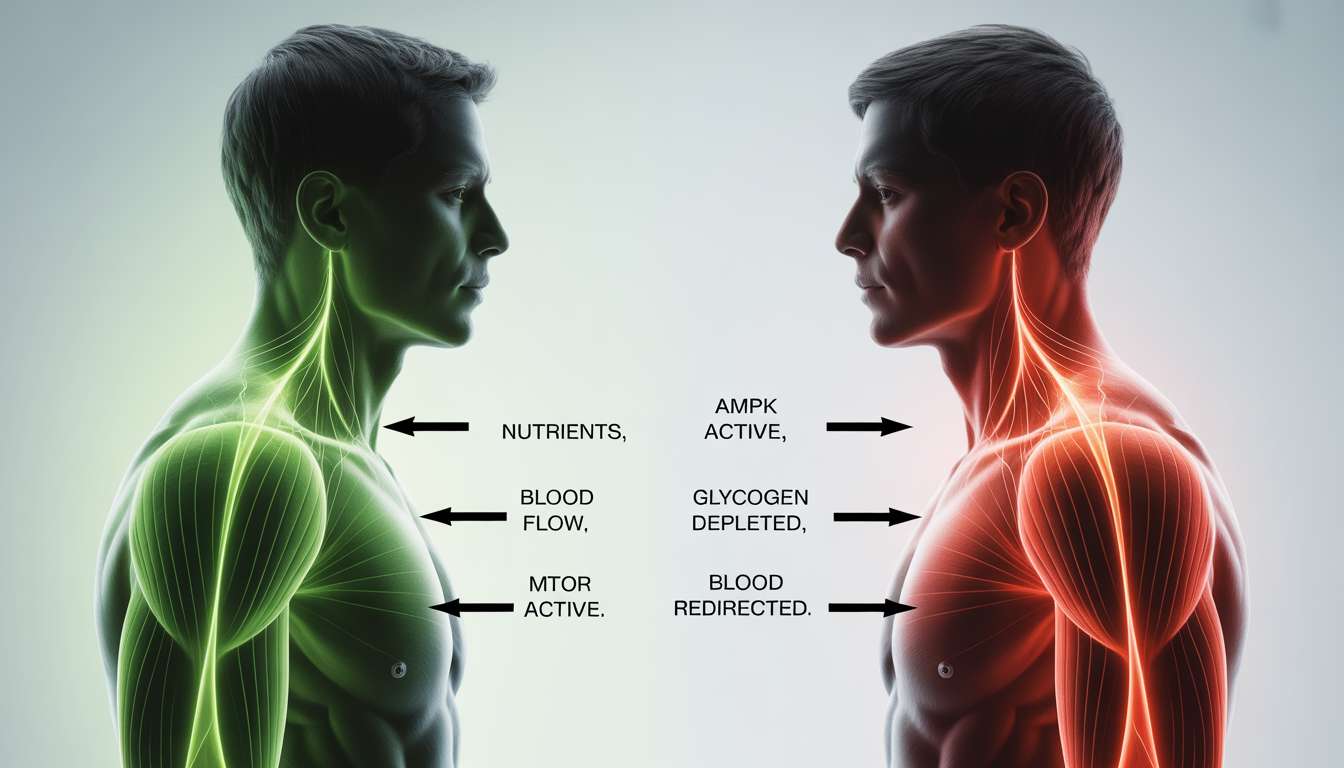
Your body, which had just entered a perfect anabolic (muscle-building) state, was yanked back into a catabolic (breakdown) state. Blood flow shifted away from your trained muscles. Glycogen continued to deplete. Growth signals got suppressed.
You didn't lose muscle. But you just muted the growth response from that workout by a measurable margin.
This was me for years. And it might be you right now.

🔎 Science Teaser: The Anabolic Window Is Real—But Cardio Can Slam It Shut
"The muscle you build is the result of the recovery you allow, not just the work you do."
—Dr. Mike Israetel, Sports Physiologist & Co-Founder, Renaissance Periodization
When you finish lifting, your body doesn't immediately start building muscle. It enters a signaling state—a biochemical green light that says, "Okay, we just got stressed. Let's adapt. Let's grow."
But that green light can turn yellow—or even red—depending on what you do in the 30–60 minutes after training.
Cardio isn't the enemy. But how, when, and how intensely you do it can be the difference between maximizing gains and leaving them on the table.
Let's dig into the science.
Dr. Mike Israetel breaks down the exact mechanisms of how cardio after lifting interferes with muscle growth—and more importantly, how to fix it. This is one of the clearest, most actionable breakdowns I've seen on the topic. Watch it. Take notes. Then keep reading for the REAP integration.
If you caught the part about mTOR vs. AMPK, you're already ahead of 90% of people in the gym. Now let's take that science and turn it into a system you can use today.
🔬Science Spotlight:
mTOR (mechanistic target of rapamycin) is the master regulator of muscle protein synthesis—it's what tells your muscles to grow. AMPK (AMP-activated protein kinase) is activated during endurance activity and directly suppresses mTOR.
Translation: Cardio that uses the same muscles you just trained can literally turn off your growth signal.
(Source: Journal of Applied Physiology, 2012)
🏋🏼 The Core Concept: What Actually Happens After You Lift?
Let's zoom in on two scenarios:
Scenario 1: You REST After Lifting
You finish your workout. You sit down. You sip your protein shake. You scroll Instagram. You drive home.
Here's what's happening inside your body:
✅Parasympathetic nervous system dominance— "Rest and digest" mode kicks in. Your body is primed for recovery.
✅Preferential blood flow to trained muscles— More oxygen, more nutrients, more growth signals.
✅High mTOR, low AMPK— The anabolic machinery is firing.
✅No further glycogen depletion— Your muscles' fuel stores begin to refill.
✅No additional local fatigue— The growth process can begin uninterrupted.
This is the ideal state for muscle growth.
Scenario 2: You Do CARDIO After Lifting
You finish your workout. You immediately hop on the treadmill, bike, or StairMaster for 30–60 minutes.
Here's what happens now:
❌Sympathetic nervous system activation— "Fight or flight" mode. Your body thinks you're still under stress.
❌Blood flow redirected away from GI tract and trained muscles— Less nutrient delivery to the muscles that need it most.
❌AMPK activation in working muscles— The catabolic (breakdown) signal directly suppresses mTOR (the growth signal).
❌Continued glycogen depletion— Your muscles' fuel tanks stay empty longer.
❌Ongoing local fatigue— The muscles you just trained are still being worked, delaying recovery.
This is a suboptimal state for muscle growth.
🌟Your Turn: Have you noticed a difference in your muscle soreness or recovery when you skip cardio after lifting vs. when you do it?
Share your experience below. Real stories fuel real change.
🏃🏼➡️ The 4 Variables That Determine Interference
Not all post-workout cardio is created equal. The degree of interference depends on four critical variables:
1. Intensity
Low intensity (Zone 2 walk, <130 bpm): Minimal interference. May even help recovery.
High intensity (HIIT, hard jogging, >150 bpm): Major interference. Sympathetic dominance, high AMPK activation.
2. Duration
<20 minutes: Negligible impact.
30–45 minutes: Noticeable impact if other variables are also wrong.
>60 minutes: Significant growth suppression, especially fasted.
3. Muscle Overlap
Different muscles (upper body lift + lower body cardio): Minimal local interference.
Same muscles (leg workout + incline walking/jogging): High local AMPK, fatigue, glycogen depletion.
4. Nutrition Timing
Sipping a protein + carb shake during cardio: Mitigates some interference.
Fasted cardio after lifting: Maximal interference. Muscles are starved during their prime growth window.
🔸 Get all four wrong (hard, long, same muscles, fasted), and you can cut your muscle-growth response by up to 50%in extreme cases.
🔸 Get most of them right, and the interference is undetectable or trivial.
🌴 The Solution: 3-Tier Strategy for Cardio + Lifting
Here's your decision tree, ranked from worst to best:
Tier 3 (Acceptable):
Low-Intensity Cardio After Lifting (20–30 min) + Shake
Keep heart rate <140 bpm (brisk walk, easy bike).
Sip a protein + carb shake during or immediately after.
Use different muscles if possible (e.g., incline walk after upper body).
Interference: 5–10% in most cases. Totally fine for most people.
Tier 2 (Better):
Low-Intensity Cardio BEFORE Lifting (20–30 min)
Use it as a warm-up.
Stay hydrated (add electrolytes if needed).
Finish lifting, then go straight into recovery mode (shake, rest, stretch).
Interference: ~0%. You get your cardio in without compromising the growth window.
Tier 1 (Best):
Separate Cardio and Lifting by ≥ 4–6 Hours
Lift in the morning, cardio in the evening (or vice versa).
Lift one day, cardio the next.
No overlap in the critical post-workout recovery window.
Interference: 0%. Maximum gains, maximum cardio benefits.

🌟Synchronicity Check:
Did one of these tiers jump out at you while reading? That's not random. Your body—and your schedule—are signaling what's actually doable for you right now. Honor that nudge. Implement that tier this week.
✨ REAP PRACTICAL APPLICATION ✨
Your 4-Step Rewire for Cardio Timing Awareness
R — Recognize & Run Out
Notice the habit: "I always do cardio right after lifting because I'm already here."
See it. Don't judge. Ask: "Is this serving my actual goal, or is it just convenient?"
E — Exchange & Envision
Replace with: "I can structure my cardio to support my muscle growth, not suppress it."
Envision: You finish your lift, drink your shake, and walk out feeling complete—not drained.
A — Activate with Action
Right now: Look at your next 7 days. Pick ONE cardio session to move to a different time or day. Just one.
That's it. One REAP rep.
P — Program & Prosper
Repeat next week. Notice how your recovery feels. Notice how your strength progresses. Let your results do the teaching.
🚨 CRITICAL WINDOW: FIRST 5 MINUTES
The REAP reps work best before the world gets its vote.
When you wake up, your brain is in theta—highly programmable. Your subconscious is wide open to suggestion.
That's why what you think, say, and feel in these first 300 seconds sets the neurological tone for the entire day.
That is your window. That's why I created:
The 5-Minute Theta Mornings Routine
No decisions. No willpower. Just open, read, rewire.
👉DOWNLOAD YOUR FREE THETA MORNINGS PDF HERE
Stack the reps, baby!
❓ FAQ (QUICK ANSWERS)
Q: Will doing cardio after lifting make me lose muscle?
A: No. In almost every real-world scenario, you won't lose muscle. But you may gain less than you otherwise could—sometimes significantly less if intensity, duration, and nutrition are all wrong.
Q: What if I only have time to do both in one session?
A: Do your cardio before lifting (as a warm-up), or keep it short, easy, and fuel it with a shake. You'll preserve 90%+ of your gains.
Q: Is this just for bodybuilders, or does it apply to regular people too?
A: It applies to anyone trying to build muscle or strength. If you're training for hypertrophy, these variables matter. If you're just moving for health, don't overthink it—but smart timing still helps.
⚡ 5-MINUTE MICRO-ACTION PLAN (START NOW)
Here's your implementation checklist. Pick ONE and do it this week:
Move your cardio session to a different day than your hardest lift (e.g., legs + cardio = separate days).
Do 15–20 min of easy cardio BEFORE your next workout instead of after.
If you must do cardio after lifting, keep it ≤30 min, low-intensity, and sip a shake during it.
Track your strength on one key lift for 2 weeks after making the change. Notice the difference.
Share this post with one training partner who's been stuck at the same strength level for months. Help them unlock what they've been leaving on the table.
Done. One REAP rep. One step closer to your perfect day.

🏖️ The Bigger Vision: Your Perfect Day, Engineered by Awareness
Perfect days are not accidents.
They are engineered—one awareness, one rep, one intelligent choice at a time.
You don't need to choose between gains and cardio. You just need to structure them intelligently.
This is how you build a life filled with Perfect Days:
✅Awareness Brings Answers.
✅REAP gives you the 5-minute on-demand rewire.
✅Show up daily: Repetition of your new habits wires in the programming leading to your perfect days.
🏃🏼➡️ YOUR NEXT STEP: Activate Your REAP & Join the Movement
✅Grab Your Free REAP Your Future: 5-Minute On-Demand Rewire PDF
A done-for-you protocol that walks you through quick problem solving and decision making.
✅Masterclass Delivery + Instant Download
Sign up below to receive the morning's masterclass link at 5:00 AM CST + get your FREE REAP PDF instantly.
👉SIGN UP HERE & GET YOUR REAP PDF NOW
✅Join the Consciousness Community Waitlist
Be first in line for the launch of The Morning Motivator Consciousness Community—where science-backed mindset meets collective intention.
📧 Email [email protected] with subject: "REAP WAITLIST"
✅Pay It Forward
Send this to one person who needs this reminder today.
Change starts with shared momentum—and your perfect day is built one post, one conversation, and one REAP at a time.
Five minutes. One REAP. One recognition. One move forward. 🚀
💖This post exists because I believe the best thing I can do for you is bring you the truth—Scientific, Soulful, and Actionable. That's the only reason I'm here.
Stay Focused. Keep Asking Better Questions!
P.S.— This is how we reach the perfect day.
Not all at once.
One deposit at a time.
One pillar at a time.
One morning at a time.
See you tomorrow at 4:44 AM.
Hey, I'm just your science-backed, soul-led, unapologetically human, mindset & motivation trainer. The content provided in this blog post is for educational and informational purposes only. I am not a licensed therapist, and this blog is NOT intended as a substitute for the advice of a physician, psychotherapist, or other qualified professional. Got it? Good. I'll catch you tomorrow.
Pay It Forward! 🚀
~Brett
TheMorningMotivator.com
You're Upgrading 1%+ Every Day! Keep Going! = +34% Monthly, +365% Better Annually!


