
Effective Reps: The 30-Second Rest Fix for Chest Growth

Stop Wasting Your Chest Workouts: The Rest Period Mistake That's Killing Your Gains!
Most of your reps are wasted. Shorten rest to 15-30 seconds and chase 20 "effective reps" to failure for real chest growth.
Fitness Friday
By Brett G Waddell ~ TheMorningMotivator.com
Don't miss tomorrow's Spotlight Saturday Upgrade: Dr. Joe Dispenza Spinal Healing: 10½ Weeks to Walk Again — free at 4:44 AM. Subscribe →
WAKE UP! Awareness Brings Answers!
You finish a set of bench press. Phone in hand. Scrolling. Watching the clock. Sixty seconds. Ninety seconds. Two minutes. Then you do it all over again—same weight, same reps, same result as last month.
I used to be that guy. Sixty seconds between sets like clockwork. Then one day I got impatient—I had to get to work—so I cut it to 30 seconds.
💪🏼 My chest felt fuller. More pumped. More alive than it ever had with longer rests.
I didn't know why it worked. I just knew it did. Turns out, what I stumbled into by accident is exactly what the science says you should do on purpose. Jeff Cavaliere calls it "effective reps."
Most guys are still resting 2-3 minutes—spending double the time for half the results, grinding through reps that don't build muscle.
Today, I'm breaking down why that 30-second rest was the best accidental discovery I ever made—and how to use it deliberately, starting with your very next workout!!
🏆 Fitness Friday UPGRADE
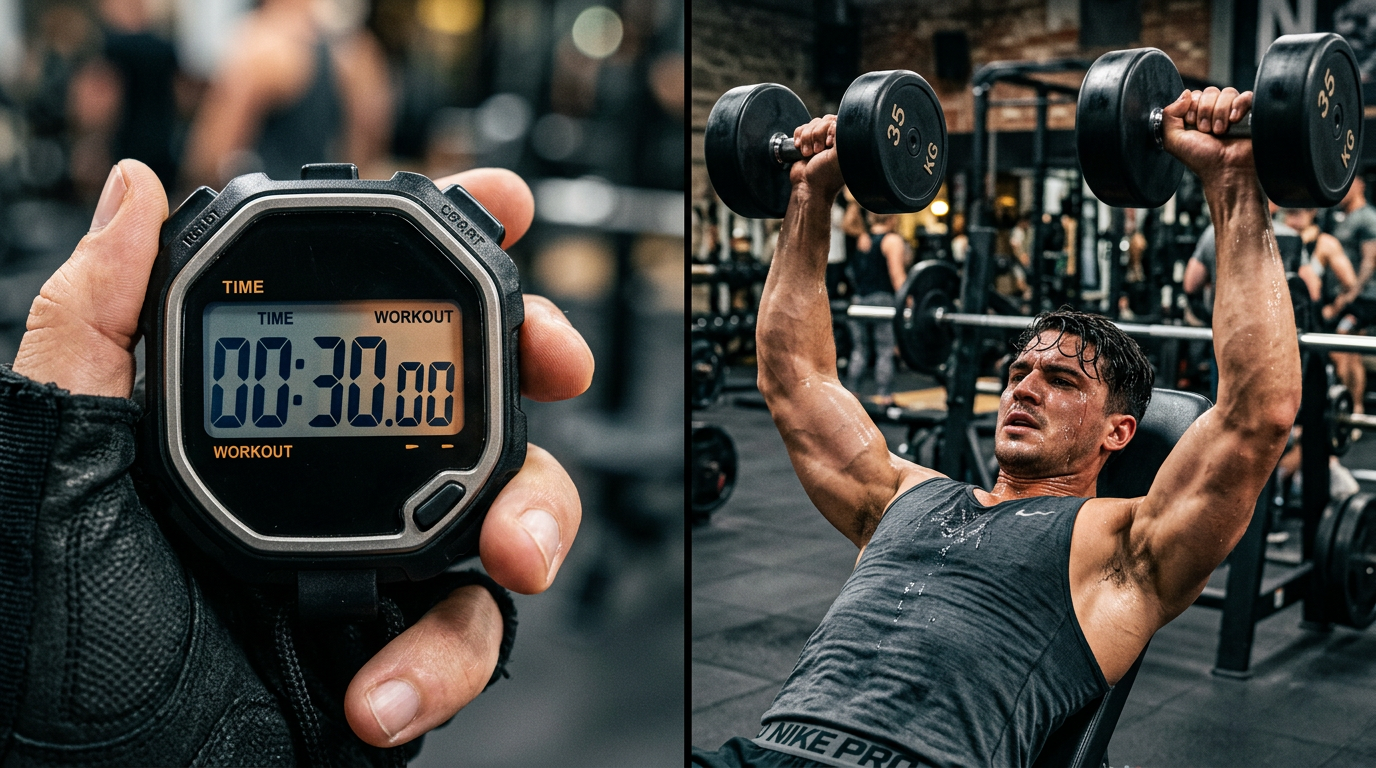
Most people rest 2-3 minutes between sets because that's what they were taught. The experts did the opposite—they shortened rest to 15-30 seconds and chased effective reps to failure. Here's the real problem: you're spending double the time for half the results.
🎖️ The Upgrade: On your very next chest workout, cut your rest to 30 seconds and push each set to true failure—then keep going until you hit 20 total effective reps.
(Full REAP breakdown and theta application below 👇)
That's not just a workout tweak. That's how you build more muscle in less time. Awareness, as always, brings answers. Here's the breakdown.
"Why do we want to continue to regenerate, to allow you to do all those sorts of ineffective reps, or those sorts of meaningless reps, the next time we go through the next set? Why can't we shortcut that process? And we can. We can do it by shortening up the rest period."
Don't have time for the full podcast? I already pulled the exact moments that matter below. Hit play if you want to see it live or keep scrolling for the breakdown.
Seeing it done makes it real. Now, let's extract the exact mechanics so you can apply this to your life today. Keep reading for the core concepts, the 5-minute audit, and the REAP framework to wire this in for good.
🌞 The Core Concept: Effective Reps
Not all reps are created equal. The first 6-7 reps of a set are just "ignition"—they get you to the point where the real muscle-building begins.
The last few grinding reps before failure? That's where hypertrophy actually happens.
Understanding this changes everything about how you rest, how you rep, and how you build!
🟢 The Ignition Set Doesn't Count
The first set with any given weight is what they call the "ignition set." Its only job is to get you to fatigue. Those first 6-7 reps? They're meaningless for growth. They're just the warm-up for the warm-up.
Once you understand this, you stop mourning the fact that you can't do as many reps on subsequent sets—because those first-set reps were never building muscle anyway.

🟡 The 20 Effective Reps Protocol
Here's how it works: Choose a weight that makes you fail in the 10-12 rep range. Perform your first set to failure—that's your ignition set, and it does NOT count toward your total. Rest 15-30 seconds.
Go again to failure. Now you're accumulating effective reps. Keep chipping away—4 reps here, 3 reps there, maybe singles or doubles toward the end—until you hit 20 total effective reps.
Once you hit 20, that exercise is DONE. Move to a different chest exercise that hits the muscle from a different angle.
🔵 Two Ways to Run It
You've got options. Option one: keep the same weight and accept that your rep counts will dwindle—possibly to singles or doubles—as you chase those 20 effective reps.
Option two: drop the weight 5-10 lbs mid-workout when your reps fall into the 2-3 range. This keeps your rep counts higher and gets you to 20 effective reps in fewer total sets. Either way works.
The rest period stays short—15 to 30 seconds—no matter which path you choose.
🟣 Beginner vs. Advanced Rest Times
Here's a nuance that matters: beginners can often rest closer to 15-20 seconds because they tend to underestimate their capabilities—they're ready to go again sooner than they think.
Advanced lifters, on the other hand, need closer to 30 seconds.
Why? Because they know what true failure feels like. They leave nothing on the table, which means they need a little more recovery to keep producing high-effort reps. As you gain experience, you'll dial this in naturally.
🟠 The Lightweight Warning
People ask: "Can I do this with light weights and high reps?" The answer is yes—but only if you push to absolute failure. If you're doing 15, 20, or 25-rep sets and stopping short of true failure, you've wasted the set.
The beginning reps are just mileage—they mean nothing unless you finish the job. Those last five or six grinding reps you don't want to do?
That's the entire point! Don't waste the beginning by skipping the end.
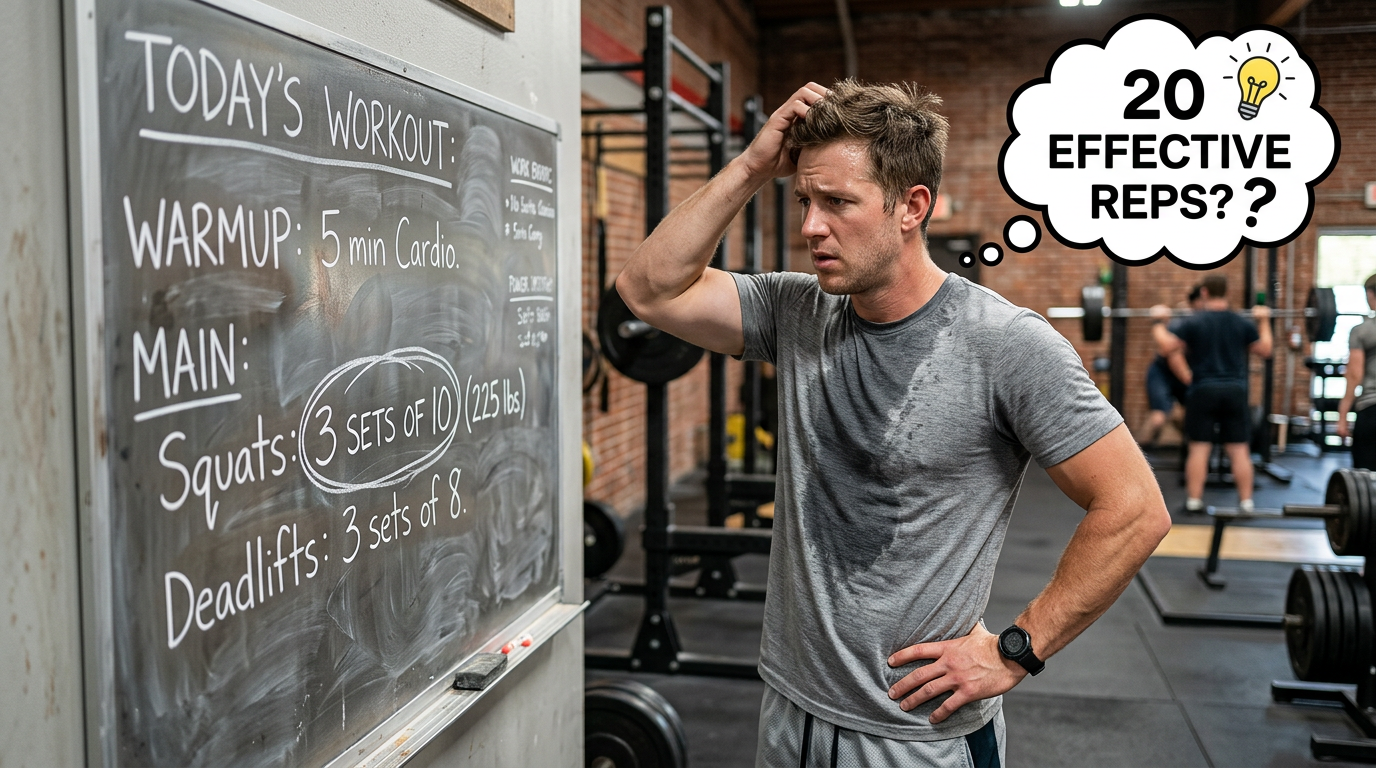
❓ Quick Reality Check (Before We Begin)
🔸 You might be thinking: "But I've always been told 8-12 reps is the only way to build muscle. Isn't this just another fitness fad?"
The Truth: No one is denying that the 8-12 range works. The shift isn't about throwing out the old—it's about expanding your toolkit. The 8-12 range builds muscle, and so do 4-6 or 20-30 reps when taken to true failure.
The science supports periodization, not rigid dogma. What matters is reaching that point of true fatigue where the real growth signal fires.
🔸 "Does this mean I have to spend hours in the gym doing endless sets to see results?"
The Truth: No. The mechanism is about quality of failure, not just quantity of volume. The 20 effective reps protocol is designed to get you in and out faster—not to add more sets.
Once you hit 20 effective reps on an exercise, you're done. Move on. The whole point is efficiency: maximum stimulus, minimum wasted time.
🚀 The REAP 5-Minute Accountability Reset
This is how we think. This is how we move. This is how we show up! Don't just read this—run one full round right now:
R — Recognize & Run Out (Minutes 1 & 2)
Name one exercise where you've been resting 2-3 minutes between sets. Fact-check it honestly: has that long rest actually built the muscle you want, or just given you more time to scroll your phone? Pause the old "this is how it's done" story.
E — Exchange + Envision + Emotion (Minutes 3 & 4)
Exchange your input. Visualize your next chest workout. Instead of resting 2 minutes and repeating the same 10 reps, envision cutting rest to 30 seconds and pushing to failure—then going again. Feel the shift from "going through the motions" to "commanding the growth signal."
A — Activate with Action (Minute 5)
Write down the one exercise you will apply the 20 effective reps protocol to in your very next workout. Commit to it before the day ends.
P — Program & Prosper (The Theta Window)
Celebrate tiny wins and lock this in during your neurological goldmine: the first 5–10 minutes after waking, or the last 5–10 before sleep. Stack the reps. Presence becomes identity. Identity becomes reality!
(Note on the science: This is the foundation of Hebbian learning—often summarized as "neurons that fire together, wire together." Repeated mental patterns physically strengthen neural pathways, a principle first established by Donald Hebb in 1949 and continuously validated in modern neuroplasticity research).

🧠 LOCK IT IN Before Your Next Set!
If this reset shifted something for you, don't let it fade by noon!
Get tomorrow's Spotlight Saturday Upgrade — Dr. Joe Dispenza Spinal Healing: 10½ Weeks to Walk Again — dropping free at 4:44 AM.
Subscribe now and get instant access to the free 2-Page REAP & Theta Mornings PDF to lock today's framework in for good. Subscribe free and get the PDF →
🎖️ Fitness Friday Upgrade: On your very next chest workout, cut your rest to 30 seconds and push each set to true failure—then keep going until you hit 20 total effective reps.
Five minutes. One shift. One upgrade. Stay focused. Keep building!
P.S. — This is how we reach the perfect day. Not all at once. One deposit at a time. One honest pattern at a time. One upgraded morning at a time. See you tomorrow at 4:44 AM.
🌱 Start Here: The Foundation
🔸 Your Genes Are the Blueprint, Your Beliefs Are the Builder: Rewiring Reality Through Epigenetics
The foundation of our biology teaching: how beliefs, environment, and repeated inputs shape the way we live. CLICK HERE →
🔸 The Illusion of Reality: Where Consciousness Research Meets Direct Experience
The beginning of our consciousness and awakening series—an invitation to question the reality you have been handed. CLICK HERE →
💖 This post exists because I believe the best thing I can do for you is bring you the truth — Scientific, Soulful, and Actionable. YOU are why I'm here—so my mistakes and research become your shortcuts!
Pay It Forward! 🚀
~Brett
TheMorningMotivator.com
We're Upgrading 1%+ Every Day! (+34% Monthly, +38% Annually!)
Medical & Training Disclaimer: Hey, I'm just your science-backed, soul-led, unapologetically human mindset & performance trainer. The content provided in this blog post is for educational and informational purposes only. I am not a licensed physician, physical therapist, or medical professional, and this blog is NOT intended as a substitute for qualified medical advice. Always consult your healthcare provider or certified coach before making major life decisions or life changes. Got it? Good. I'll catch you tomorrow. Peace out!


