
How to Exercise to Live Longer: Dr. Sinclair's 7:1 Method

Why "I Don't Have Time to Exercise" Is Wrong About Living Longer — The 3 Pillars That Pay You 7 Minutes of Life for Every Minute You Train
Harvard's Dr. David Sinclair: each exercise minute buys ~7 minutes of life. Train cardio, strength, and balance weekly.
Fitness Friday
By Brett G Waddell ~TheMorningMotivator.com
WAKE UP! Awareness Brings Answers!
Great Morning, Super Humans!
I’m always hunting for the ultimate edge to help us crush our daily goals and add vibrant, unstoppable years to our lives.
We all know we should be working out, but let's be honest: we're training for a beach body, a personal best, or just to burn off stress. Rarely for the one thing that actually matters most.
What if you’re leaving the most powerful anti-aging "drug" on the table because you aren't training specifically for longevity?
To help us upgrade our routines, protect our muscle mass, and separate fitness fiction from biological fact, I’ve brought in the ultimate expert: Harvard geneticist and longevity scientist Dr. David Sinclair.
He’s here to break down the exact science of how to move, lift, and recover to literally slow down your biological clock. Grab your coffee, and let’s dive into the ultimate blueprint for a longer, stronger life!
"No existing drug on the planet compares to what exercise can do for our health and aging." — Dr. David Sinclair
Before you keep reading, hit play. Nothing I write captures this as clearly as watching it done.
That's the same framework I used, alone, in a mirror, before any of this existed. Keep reading — here's exactly how it works. Bookmark this page... all the video details are easy to read below.
🌞 The Core Concept: The Longevity Training Blueprint — 3 Biomarkers, 3 Pillars, 1 Weekly Plan
Training for longevity is not training for a sport or a beach body. As Dr. Sinclair frames it in the episode, exercising for longevity differs from exercising for pleasure, general health, or a specific sport — it's a targeted prescription for your biological age.
Here's the full breakdown from his lab and the studies he cites.
📈 The Math That Changes Everything
7:1 return — ~7 minutes of life gained per minute exercised (Lancet, 2011).
Top 25% active = +5.3 years on average; one hour of walking adds 6.3 hours of life for the sedentary (BJSM, 2025).
Olympians live ~5.1 years longer than the general population, with lower cancer and cardiovascular risk.
No existing drug on the planet compares to what exercise does for health and aging.
🧬 The 3 Biomarkers That Predict Your Lifespan
🟢 Grip strength
One of the most robust low-tech aging biomarkers; a proxy for overall muscle tone and strength training history. It peaks around age 30, then declines — and higher grip strength tracks with lower fatality from falls, cancer, cardiovascular disease, and dementia.
Test it: hang from a pull-up bar.
20s: 45–90 sec.
30s–40s: 30–75 sec.
50s: 20–45 sec.
60s: 15–30 sec.
70s+: hanging at all is a strong sign of healthy aging.
🔵 VO2 max
How much oxygen you use at max effort. In a 2018 JAMA Network Open study, the lowest fitness group had a 404% higher all-cause mortality risk than the elite group.
Excellent benchmarks: above
~51 for men in their 20s,
~45+ for women — declining
~10% per decade, faster if sedentary.
Measure via a sports lab mask test (most accurate) or a quality wearable estimate.
🟣 Balance
Deteriorates from your mid-50s as neuromuscular junctions, proprioception, and processing speed age.
In a 2022 BJSM study, people 51–75 who couldn't hold a 10-second one-legged stance were 84% more likely to die than those who could.
💥 The good news: balance is highly trainable!

🏛️ The 3 Pillars of Your Weekly Prescription
🫀 Pillar 1 — Cardiovascular:
75 min vigorous (running, swim laps, singles tennis — hard to hold a conversation) OR 150 min moderate (brisk walking, easy cycling — you can still talk), spread across the week.
🏋️ Pillar 2 — Strength:
Hit every major muscle group at least 2x/week (2x beats 1x, clearly). 12–20 weekly sets per muscle group is the optimal hypertrophy range.
Sample 4-day split: Push (chest/triceps/front delts) → Pull (back/biceps/rear delts) → Legs → Full-body second hit.
Why it matters beyond looks: muscle loss begins within days of disuse — even in young people — so you're building a muscle reserve for surgeries, injuries, and old age.
🤸 Pillar 3 — Balance:
Yoga, martial arts, dance, Zumba, Pilates — fun, social, and multicomponent.
A 2017 study showed 12 weeks of yoga + meditation lowered DNA-damage marker 8-OHdG, cortisol, and IL-6, while raising telomerase, BDNF, and SIRT1.
That's cellular aging moving in the right direction!
⚖️ The Goldilocks Zone: How Much Is Too Much?
Near-max benefit:
2.5–5 hrs vigorous or 5–10 hrs moderate per week (Circulation, 2022 — 100,000+ adults, 30-year follow-up). More is not better; hormesis needs rest to work.
Extreme endurance caution:
An abstract in the Journal of Clinical Oncology linked sustained ultramarathon-level running to colon tumor risk — early signal, cause unknown, and totally unnecessary for longevity benefits.
Your recovery dashboard:
Day-to-day HRV drops over 10–20%, a rising morning heart rate, poor sleep, elevated CK, or a disrupted cortisol rhythm = your body isn't recovering. As Dr. Sinclair says, you can't consistently improve anything you don't measure.
🍳 Fuel: Protein, Fasting, and the mTOR Pulse
Protein target:
~1.2–2 g per kg of body weight daily (higher for older adults and heavy trainers). The "30-minute anabolic window" is mostly myth — total daily intake matters most; just spread protein across at least two meals.
Plant vs. animal:
A 2025 meta-analysis in Sports Medicine Open found muscular strength is not compromised by plant-based diets. Variety is the key (rice + beans complements amino acids); vegans should watch B vitamins and iron.
The mTOR pulse:
mTOR is your amino-acid sensor — short bursts after training or protein build muscle (healthy); chronic activation from constant eating suppresses autophagy, the cell's cleanup system. Pulse it on with training, off with fasting. That's how you build muscle and longevity at once.
Caffeine:
Improves exercise performance — especially aerobic (BJSM, 2020, "Wake up and smell the coffee"). Skip sugary ultra-processed energy drinks. Coffee and tea both associate with lower all-cause mortality.
Fasting + training:
Put intense sessions in your eating window; keep fasted sessions light-to-moderate; hydrate aggressively — fasting increases fluid loss.

⏰ Timing: Weekend Warriors, Chronotypes, and the 4-Hour Rule
Weekend warriors win too:
2025 data (BMC Public Health, 150,000 adults) shows weekend-only exercisers get substantially lower all-cause mortality — though daily movement beats it for sleep, and "exercise snacks" (stairs, parking far, carrying luggage, standing desk, pacing on calls) all count toward your total.
Match your chronotype:
Early birds peak earlier; night owls later. Peak human performance generally runs 4–8 PM. But consistency matters most — regular timing acts as a zeitgeber, teaching your muscles' clocks when to prime.
The 4-hour rule:
A 2025 Whoop study of 14,000+ people across 4 million nights found strenuous evening exercise delays sleep and worsens quality — but ending at least 4 hours before bed shows no disruption.
🧠 Myth-Busting Lab
❌ "Women need a completely different program." → Same muscles, same stimuli, similar proportional gains. Marketing overcomplicates it. Women especially need heavy strength training to bank bone density before the post-menopausal estrogen drop. Current science shows no consistent advantage to cycle-syncing workouts.
❌ "Lifting gives men a big long-term testosterone boost." → The post-lift spike is transient. The real win: better body composition and insulin sensitivity → healthier resting hormones, especially when metabolic health has room to improve.
❌ "My joints hurt, so I should rest." → Stopping makes joints deteriorate faster. Specific movement (pendulum swings and banded rows for shoulders; sit-to-stands, step-ups, glute bridges for hips and knees) rebuilds the support system.
❌ "I'm too old to start." → In the LIFTMOR trial, postmenopausal women with low bone mass (avg age 65) lifted heavy twice a week with zero fractures and gained bone density — and centenarians reduced frailty in 12 weeks. It is never too late.
❌ "GLP-1 drugs will waste my muscle." → Some lean mass loss is real — but a 2026 Cell Reports Medicine pilot found people on GLP-1s who train largely preserve strength and improve relative muscle mass. Lift + eat protein, and you can maintain — even build — muscle on these drugs.
🚀 Solution: 5-Minute Longevity Audit — Run One Full Round
Here's how to apply that in the next five minutes, today:
Minute 1 — Run the 10-Second Test:
Stand near a wall for safety and hold a one-legged stance for 10 seconds. Note the result. Bonus: dead-hang a pull-up bar or squeeze a grip trainer and note your seconds. That's your baseline biomarker — you can't improve what you don't measure.
Minute 2 — Book the Three Pillars:
Open your calendar and lock in this week: two strength sessions, one balance session (yoga, dance, martial arts), and your cardio blocks (75 vigorous or 150 moderate minutes). Scheduled = done.
Minute 3 — Pick Two Exercise Snacks:
Stairs over elevator. Park at the back of the lot. Pace during calls. Carry the luggage. Choose two and run them today — sneaky minutes that compound at 7:1.
Minute 4 — Hit Your Protein Number:
Multiply your body weight in kg by 1.2–2. That's your daily gram target. Split it across at least two meals — and if you train fasted, break your fast with protein.
Minute 5 — Set the 4-Hour Cutoff:
Decide your training time, keep it consistent so your body clock primes for it, and hard sessions end at least 4 hours before bed. Protect the sleep that rebuilds the muscle.
This isn't about becoming an athlete. It's about precision — giving your body the exact stimulus science says pays you back sevenfold.
🌀 If this shifted something for you, there's more where it came from! Get a daily upgrade like this dropped in your inbox every morning at 4:44 AM. Subscribe Free →

❓ FAQ
Q: I barely have 15 free minutes a day — is it even worth starting?
A: Yes — that's literally the dose. The Lancet study found 15 minutes a day correlated with 3 extra years of life expectancy, and even "weekend warrior" patterns significantly lower mortality. And remember the snacks: stairs, parking far, pacing on calls. The weekly total matters more than the perfect schedule.
Q: I'm in my 50s, 60s, or beyond with stiff joints — isn't serious training dangerous now?
A: The opposite. Rest makes joints deteriorate faster; specific movement rebuilds them. In LIFTMOR, women averaging 65 with osteopenia/osteoporosis lifted heavy twice a week with zero fractures and gained bone density — and centenarians reduced frailty in 12 weeks. Start where you are, progress the load gradually, and let consistency do the compounding.
Q: Do women need a totally different program than men?
A: No. Same muscles, same stimuli, similar proportional strength gains — the "separate science for women" marketing is a barrier, not biology. The one priority difference: women should bank bone density with strength training throughout adulthood to offset the post-menopausal estrogen drop. The foundations are universal.
🌞 REAP Practical Application: The Movement Reframe
This is how we think. This is how we move. This is how we show up!
Watching Dr. Sinclair lay out how every rep, every meal, and every night of sleep writes instructions into your biology reminded me exactly why I built REAP: information alone doesn't change your body — a repeated loop does.
This is the loop that turns today's science into a lifetime of movement.
R — Recognize & Run Out: Notice the old pattern: "I'll start when I have more time." Pause. Ask: has waiting for more time ever actually produced more time?
E — Exchange + Envision + Emotion: Replace it with: "Every minute I move buys me seven." Feel that land — not a chore, a deposit. See yourself at 80 hanging from that bar.
A — Activate with Action: Run the 5-Minute Longevity Audit above — one-legged test, calendar blocks, two snacks, protein number, 4-hour cutoff. Today, not Monday.
P — Program & Prosper: Use this inside your theta window — the first 5–10 minutes after waking, or the last 5–10 before sleep. Visualize the person who never negotiates with the alarm. Stack the reps. Presence becomes identity. Identity becomes reality.
"Neurons that fire together, wire together." — Donald Hebb
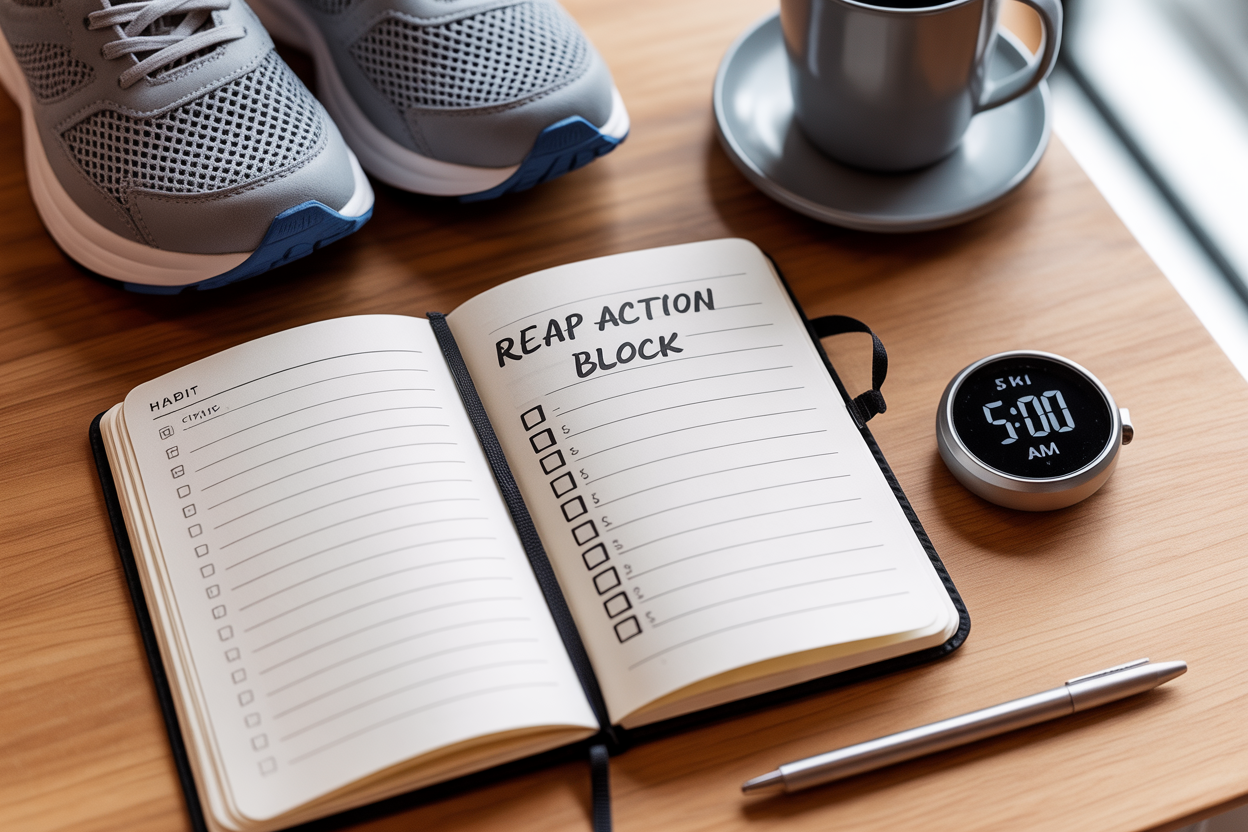
🚨 Critical Window: Your 5-Minute Theta Mornings
The first 5–10 minutes after you wake up is neurological gold!
Your brain is still in a more receptive theta state — the exact window to feed your mind the input you actually want wired in, instead of whatever the group chat throws at you first.
That's why I built the 5-Minute Theta Mornings Routine: no decisions, no overthinking, just a simple practice to program your mind for strength, presence, and purpose. Today's audit fits into this same window — you're controlling your body's input before the world hands you its own script.
🌟 Synchronicity Check: If you felt a twinge of "I should really start moving again" while reading this, that's not random. Something in you already knows. Honor that. Name it today.
💪🏼 Subscribe Free and get your Theta Mornings PDF → Program... don't be programmed.
🏖️ The Bigger Vision
Perfect days are engineered. One decision. One behavior. One moment of awareness at a time.
You don't need more hours to add years. You need seven minutes returned for every one invested, three pillars hit each week, and the willingness to stop negotiating with the alarm.
That's not a fitness trend. That's a Tuesday-morning decision, repeated until it becomes who you are.
This is the mission: Awareness → REAP → Repetition → Identity → Reality.

🤸🏼 Your Next Step
✅ If this shifted something for you, there is more where it came from — every single day at 4:44 AM. Subscribe Free and get your Theta Mornings PDF →
✅ Share this with someone who's been waiting for "more time" to start training for their later years.
Five minutes. Three pillars. One 7:1 return. Stay focused. Keep asking better questions.
P.S. — This is how we reach the perfect day. Not all at once. One rep at a time. One deposit at a time. One upgraded morning at a time. See you tomorrow at 4:44 AM.
🌱 Start Here: The Foundation
🔸 Your Genes Are the Blueprint, Your Beliefs Are the Builder: Rewiring Reality Through Epigenetics
The foundation of our biology teaching: how beliefs, environment, and repeated inputs shape the way we live.
🔸 The Illusion of Reality: Where Consciousness Research Meets Direct Experience
The beginning of our consciousness and awakening series—an invitation to question the reality you have been handed.
💖 This post exists because I believe the best thing I can do for you is bring you the truth — Scientific, Soulful, and Actionable. YOU are why I'm here—so my mistakes and research become your shortcuts!
Pay It Forward! 🚀
~Brett
TheMorningMotivator.com
We're Upgrading 1%+ Every Day! (+34% Monthly, +38% Annually!)
Medical & Training Disclaimer: Hey, I'm just your science-backed, soul-led, unapologetically human mindset & performance trainer. The content provided in this blog post is for educational and informational purposes only. I am not a licensed physician, physical therapist, or Medical Professional, and this blog is NOT intended as a substitute for qualified medical advice. Always consult your healthcare provider or certified coach before making major life decisions or life changes. Got it? Good. I'll catch you tomorrow. Peace out!


