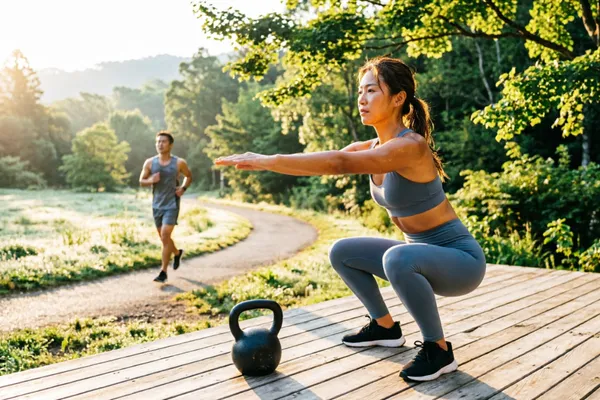
7 Exercises That Reverse Aging, Backed by Science

7 Movements That Reverse Aging — Not Just Slow It Down
Grip, cardio, mobility, power, and load — 7 science-backed exercises a 46-year-old trainer uses to outmove people half his age.
Fitness Friday
By Brett G Waddell ~TheMorningMotivator.com
WAKE UP! Awareness Brings Answers!
Most people think getting older is a one-way street — you get stiffer, you get weaker, and eventually you lose your independence.
That belief is so common we treat it like a law of physics. It's not.
I came across a strength coach who's 46 himself and has spent years running these exact protocols with clients from their 30s all the way into their 70s — and the pattern he keeps seeing is people walking away moving and feeling better than people half their age.
He didn't build this list around fitness trends. He built it around the specific things that quietly break down as we age — grip, cardio capacity, hip mobility, power, and load-bearing strength — and gave each one a science-backed fix.
So I broke down every movement below — no video required. Here's exactly what he teaches.
🟠 Today's Upgrade 🟠
Grab your notebook. Pick one exercise you're not doing. Try it today — see how it feels. If it lands, wire it in with REAP.
"Strength keeps you alive, but power is what keeps you young." — from today's training video
Before you keep reading, hit play. Nothing I write captures this as clearly as watching it done.
That's the exact protocol he uses on himself and on clients from their 30s to their 70s — and it's the same one you're about to apply in five minutes. Keep reading — here's exactly how it works.
🌞 The Core Concept: Seven Systems That Quietly Age You
Aging isn't one dial turning down — it's several separate systems breaking down in parallel: your grip and spine, your cardiovascular engine, your joint mobility, your cellular energy, your power output, and your ability to carry load. Neglect one, and the others can't cover for it.
🟢 Exercise 1 — The Bar Hang
Hanging decompresses your spine, rebuilds your shoulders, and trains a number researchers now use as a straight-up biomarker for longevity: grip strength.
Beginner: Chair-assisted hang, weight partially supported. Accumulate 5–10 second holds.
Intermediate: Full dead hang, 20–60 seconds, ribs down, neck long. Build to 2 minutes a day.
Advanced: Work up to 3 minutes a day across variations — mixed grips, scapular pulls, one-arm hangs.
The science: A 2018 BMJ study found low grip strength is one of the strongest predictors of early death — linked to heart disease, cancer, and all-cause mortality.
Client win: Mark, 52, went from a 5-second assisted hang to a 30-second unassisted hang in weeks. His shoulders hadn't felt this free in 20 years.
🟡 Exercise 2 — Japanese Interval Walking (IWT)
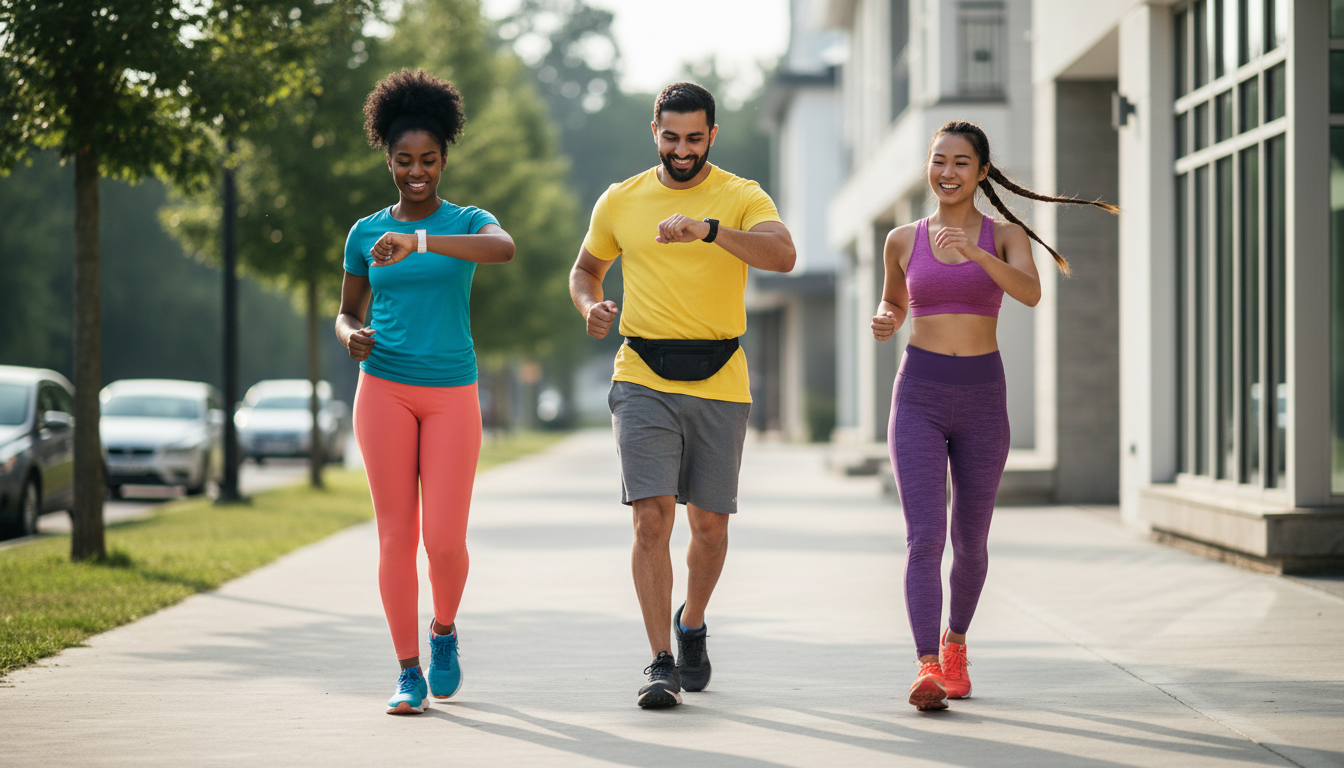
Your VO2 max — your cardiovascular fitness — drops about 10% per decade after 30. IWT, developed in Japan by Dr. Hiroshi Nose, is one of the most effective ways to reverse that decline.
The protocol: 3 minutes fast walking (~70% effort), 3 minutes slow. Repeat for 30 minutes, 4 days a week.
Beginner: 2 minutes fast / 3 minutes slow.
Intermediate: Full 3-and-3 protocol, full 30 minutes.
Advanced: Add incline, a weighted vest, or a rucksack.
The science: The original study showed adults over 60 doing IWT improved VO2 max, leg strength, and blood pressure by significant margins — more than steady-state walkers — in just 5 months.
Client win: David, 47, used to get calf cramps before finishing a Saturday hike. After 8 weeks of IWT, he sent a video of himself at the summit with his kids.
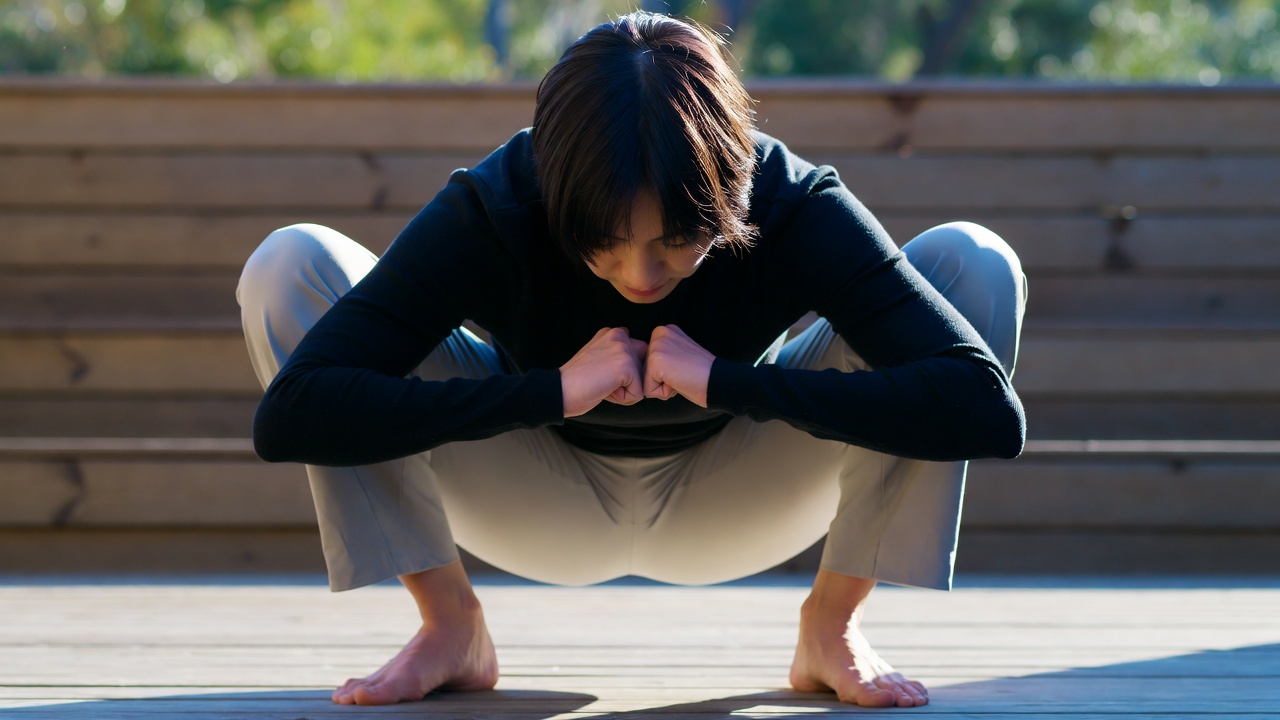
🟠 Exercise 3 — The Asian Squat
This isn't a gym exercise — it's the human resting position. It's simply squatting all the way down with your heels flat on the ground, hips below your knees, holding that position. Losing it means losing ankle mobility, hip function, spinal health, and eventually independence.
Beginner: Hold a door frame or couch for support, heels elevated on books or a small plate. Accumulate 2–5 minutes a day.
Intermediate: Unassisted squat, chest tall. Aim for 5–10 minutes a day, broken up across the day.
Advanced: Explore different stances — wider, asymmetric, reaching overhead.
The science: A 2012 study in the European Journal of Preventive Cardiology found people who struggle to sit down and rise from the floor were five times more likely to die within the next 6 years.
Client win: Pamela hadn't sat in a deep squat for decades. A couple months in, she could — and messaged the team in tears of joy.
🔵 Exercise 4 — The World's Greatest Stretch
One flow that hits every joint that locks down first as you age. You step into a deep lunge, drop your back hip low, plant your hands inside your front foot, then rotate your torso and reach one arm straight up toward the ceiling — hitting hips, T-spine, ankles, calves, and shoulders in a single continuous movement. Stiffness in any one of these shows up everywhere else.
Beginner: Walk through the positions slowly, hold each for two breaths, skip the rotation.
Intermediate: Full flow with T-spine rotation, three reps per side.
Advanced: Add an overhead reach or hold a light weight during the rotation.
The science: Hip mobility alone is one of the biggest predictors of fall risk in older adults — and falls are the second leading cause of accidental death worldwide.
Client win: Sharon couldn't bend down to tie her shoes without her lower back screaming. Three weeks after adding this stretch to her mornings, the pain was gone.
🟣 Exercise 5 — Zone 2 Cardio
Inside every cell are mitochondria — tiny energy factories that shrink in number and quality as you age. Zone 2 cardio is the single most effective way to reverse that.
The pace: Conversational but slightly labored — roughly 60–70% of max heart rate.
Beginner: Three brisk 30-minute walks a week (the IWT above counts).
Intermediate: Four 45-minute sessions — walk, cycle, or row easy.
Advanced: Four 60-minute sessions, ideally with a heart rate monitor.
The science: A 2018 JAMA study found low cardiorespiratory fitness was a stronger predictor of early death than smoking, diabetes, or heart disease.
Client win: Kevin, 51, couldn't keep up with his teenage son on hikes. Three Zone 2 sessions a week later, he's the one waiting at the top.

🔴 Exercise 6 — Plyometrics
Strength declines slowly with age. Power — strength multiplied by speed — declines almost twice as fast, about 3–4% a year after 40. Power is what keeps you from falling, and what lets you catch yourself when you do trip.
Beginner: Low impact — ankle pogos, calf jumps, line hops. The ground should barely make a sound.
Intermediate: Broad jumps, skater bounds, low box jumps — learning to absorb force.
Advanced: Depth jumps, bounding, single-leg hops — training the nervous system to produce force fast.
The science: Power loss in older adults is the single biggest predictor of fall-related death — bigger than strength loss, bigger than balance.
Client win: Robert, 58, fell on a ski trip and couldn't get up without help. Six months of progressive plyo later, he's hitting box jumps and says he hasn't felt this athletic since college.
🟢 Exercise 7 — Loaded Carries
One movement trains muscular endurance, grip, core, posture, breathing, and full-body structural integrity at once — and it mimics real life: groceries, luggage, kids, furniture.
Beginner: Suitcase carry — one kettlebell, one hand, 30 seconds per side. Stand tall, don't lean.
Intermediate: Farmer's carry — both hands, heavier load, 60 seconds.
Advanced: Heavy farmer carries at bodyweight for at least 1 minute, plus overhead carries and mixed-grip variations.
The expert view: One of the field's leading spine researchers calls loaded carries one of the single best exercises for spinal stability and core integrity.
Client win: Lisa wanted to carry her own suitcase through the airport without help. Now she carries her grandkids on her shoulders.
🚀 Your 5-Minute Movement Audit — Do This Right Now
Minute 1 — Test your hang: assisted or unassisted, see how long you last.
Minute 2 — Drop into a squat, heels down if you can. Notice where you're tight.
Minute 3 — Run the World's Greatest Stretch, one full round, both sides.
Minute 4 — Do 10 slow ankle pogos. Land quiet.
Minute 5 — Pick your one non-negotiable: which of these seven are you actually doing daily, starting tomorrow?
🌀 If this shifted something for you, there's more where it came from! Get a daily upgrade like this dropped in your inbox every morning. Subscribe Free →
❓ FAQ
Q: I'm over 50 — is it too late to start?
A: No. The client examples above range from their 40s into their 70s, and the biggest gains often show up fastest in people who've been sedentary longest. Start at the beginner level and progress from there.
Q: Do I need a gym or equipment?
A: Not for most of these. A door frame, a couch, or a pull-up bar covers the bar hang; the rest of the list uses bodyweight, a sidewalk, or a single kettlebell.
Q: How do I know which level — beginner, intermediate, advanced — to start at?
A: Match your level to where your body is right now, not where you want it to be. If a movement feels hard to control at intermediate, drop to beginner. Progress happens by rep, not by ego.
🌞 REAP Practical Application: Programming Movement Into Identity
R — Recognize & Run Out: Notice the old pattern: "I'll start exercising when I have more time." Pause. Ask: has waiting ever actually made it easier?
E — Exchange + Envision + Emotion: Replace it with: "Five minutes today rewires the person I'm becoming." Feel what that lands as — not pressure, possibility.
A — Activate with Action: Pick one exercise from the seven and do the beginner version right now, today — not the whole list, just one.
P — Program & Prosper: Stack that one movement inside your theta window — the first 5–10 minutes after waking. Repetition becomes identity. Identity becomes reality.
"Neurons that fire together, wire together." — Donald Hebb

🚨 Critical Window: Your 5-Minute Theta Mornings
The first 5–10 minutes after you wake up is neurological gold — and it's also when your body is stiffest and least resistant to change.
That's the exact window to stack one movement from today's list, before the day's decisions crowd it out.
That's why I built the 5-Minute Theta Mornings Routine — no decisions, no overthinking, just a simple practice to program your mind and body for strength, presence, and purpose.
🌟 Synchronicity Check: If your knees, hips, or shoulders remind you they exist sometime today, that's not bad luck — that's the exact system your body is asking you to train. Honor it. Pick the movement today.
💪🏼 Subscribe Free and get your Theta Mornings PDF → Program... don't be programmed.
🏖️ The Bigger Vision
Aging well is engineered, one rep at a time.
You don't need a perfect program or ideal conditions to start reversing decades of decline — you need five minutes, one movement, and the willingness to do the beginner version today.
That's not a fitness trend. That's a Friday-morning decision, repeated until it becomes who you are.
This is the mission: Awareness → REAP → Repetition → Identity → Reality.
🏃🏼 Your Next Step
✅ If this shifted something for you, there is more where it came from — every single day at 4:44 AM. Subscribe Free and get your Theta Mornings PDF →
✅ Share this with someone who thinks getting older means giving up their independence.
🟠 Today's Upgrade: Grab your notebook. Pick one exercise you're not doing. Try it today — see how it feels. If it lands, wire it in with REAP. ✨
Five minutes. One movement. One upgrade. Stay strong. Keep moving.
P.S. — This is how we reach the perfect day. Not all at once. One rep at a time. One honest movement at a time. One upgraded morning at a time. See you tomorrow at 4:44 AM.
🌱 Start Here: The Foundation
🔸 Your Genes Are the Blueprint, Your Beliefs Are the Builder: Rewiring Reality Through Epigenetics The foundation of our biology teaching: how beliefs, environment, and repeated inputs shape the way we live.
🔸 The Illusion of Reality: Where Consciousness Research Meets Direct Experience The beginning of our consciousness and awakening series—an invitation to question the reality you've been handed.
💖This post exists because I believe the best thing I can do for you is bring you the truth — Scientific, Soulful, and Actionable. YOU are why I'm here—so my mistakes and research become your shortcuts!
Pay It Forward! 🚀
~Brett
TheMorningMotivator.com
We're Upgrading 1%+ Every Day! (+34% Monthly, +38% Annually!)
Medical & Training Disclaimer: Hey, I'm just your science-backed, soul-led, unapologetically human mindset & performance trainer. The content provided in this blog post is for educational and informational purposes only. I am not a licensed physician, physical therapist, or medical professional, and this blog is NOT intended as a substitute for qualified medical advice. Always consult your healthcare provider or certified coach before making major life decisions or life changes. Got it? Good. I'll catch you tomorrow. Peace out!


