
7 Stoic Time Secrets to Stop Wasting Your Life

7 Stoic Time Secrets That Will Change How You See Every Waking Minute
Seneca taught that time is dying with every passing minute. These 7 Stoic strategies help you stop wasting it and start living intentionally.
Tactical Tuesday
By Brett G Waddell ~ TheMorningMotivator.com
Don't miss tomorrow's Wellness Wednesday Upgrade: — Stop Wasting Money on Supplements — A Neuroscientist's Brutal 5-Pill Truth — free at 4:44 AM. Subscribe →
WAKE UP! Awareness Brings Answers!
I used to hit snooze three times every morning. Not because I was tired—because I was avoiding.
Avoiding the run I knew I needed. Avoiding the hard thing that would actually make me feel alive.
And here's what scared me: I've done this before. Hundreds of times. I've let the warm covers win. I've told myself "tomorrow." But tomorrow is a lie we tell ourselves to avoid the discomfort of now.
And the cost? Days bleed into weeks. Weeks into years.
And suddenly you're the person Seneca described—walking through life on autopilot, following "wretched habit," paying for your aimlessness with your most precious resource. Not money. Not status. Your life.
I brought in Ryan Holiday today — the bestselling author who's spent his career translating Stoic philosophy for modern life — and he's going to show us something uncomfortable but liberating: death isn't waiting for you in the future. It's happening right now. Every minute you waste, you're dying.
But here's the good news—once you see it, you can't unsee it. And that clarity? That's where the seven strategies we're breaking down today come in. They're not productivity hacks. They're a philosophy for actually living before your time runs out.
Everything is broken down piece by piece, so you can pull out exactly what you need. Quick read now. Quick reference later. Let's get into it.
🏆 Tactical Tuesday UPGRADE
Most people wake up and immediately check their phone—flooding their brain with other people's priorities before they've even claimed their own.
The Stoics did the opposite: they started the day by conquering themselves first. Here's the real problem: you're not lacking time—you're lacking ownership of it.
🎖️ The Upgrade: Tomorrow morning, before you touch your phone, go outside and move your body for 5 minutes. Walk, run, stretch—just own the first moments of your day.
(Full REAP breakdown and theta application below 👇)
That's not just a morning routine. That's how you reclaim your life from autopilot. Awareness, as always, brings answers. Here's the breakdown.
"As we kill time, time kills us. He says we're dying every minute. We're dying every day. So the reason we have to say no, the reason we have to design our lives, the reason we have to be conscious of where we're going and what we're doing—so we don't know how long we have."
Don't have time for the full podcast? I already pulled the exact moments that matter below. Hit play if you want to see it live, or keep scrolling for the breakdown.
Seeing it done makes it real. Now, let's extract the exact mechanics so you can apply this to your life today. Keep reading for the core concepts, the 5-minute audit, and the REAP framework to wire this in for good.
🌞 The Core Concept: Time Is Dying
Seneca observed that most Romans walked through their days without purpose—following what he called "wretched habit."
They did what everyone else did. They did what they'd always done. And they paid for this aimlessness with their lives.
The most powerful lesson? Death isn't a future event. It's happening now. As time passes, it belongs to death forever. We are dying every minute. We are dying every day.
🟢 Rule 1: Own Your Mornings—Conquer Yourself First
If you want to feel like a king, get up early and go for a run. The streets are empty. It's just you, pushing yourself, challenging yourself. You might not rule over the city—but you are ruling over yourself. And that is, in a way, the hardest thing to do.
Marcus Aurelius wrote: "When you have trouble getting out of bed, say to yourself: Is this what I was put here to do? To huddle under the covers and stay warm?" No. Get up. Go do what your duty demands.
It's not fun in the moment. But you're always glad afterward. You feel powerful over yourself—which is the whole point.
Key Takeaways:
Win the first battle of the day: getting up.
Rule yourself before you try to rule anything else.
The discomfort is temporary. The pride is permanent.
🟡 Rule 2: Train Focus in Chaos—Don't Wait for Perfect Conditions
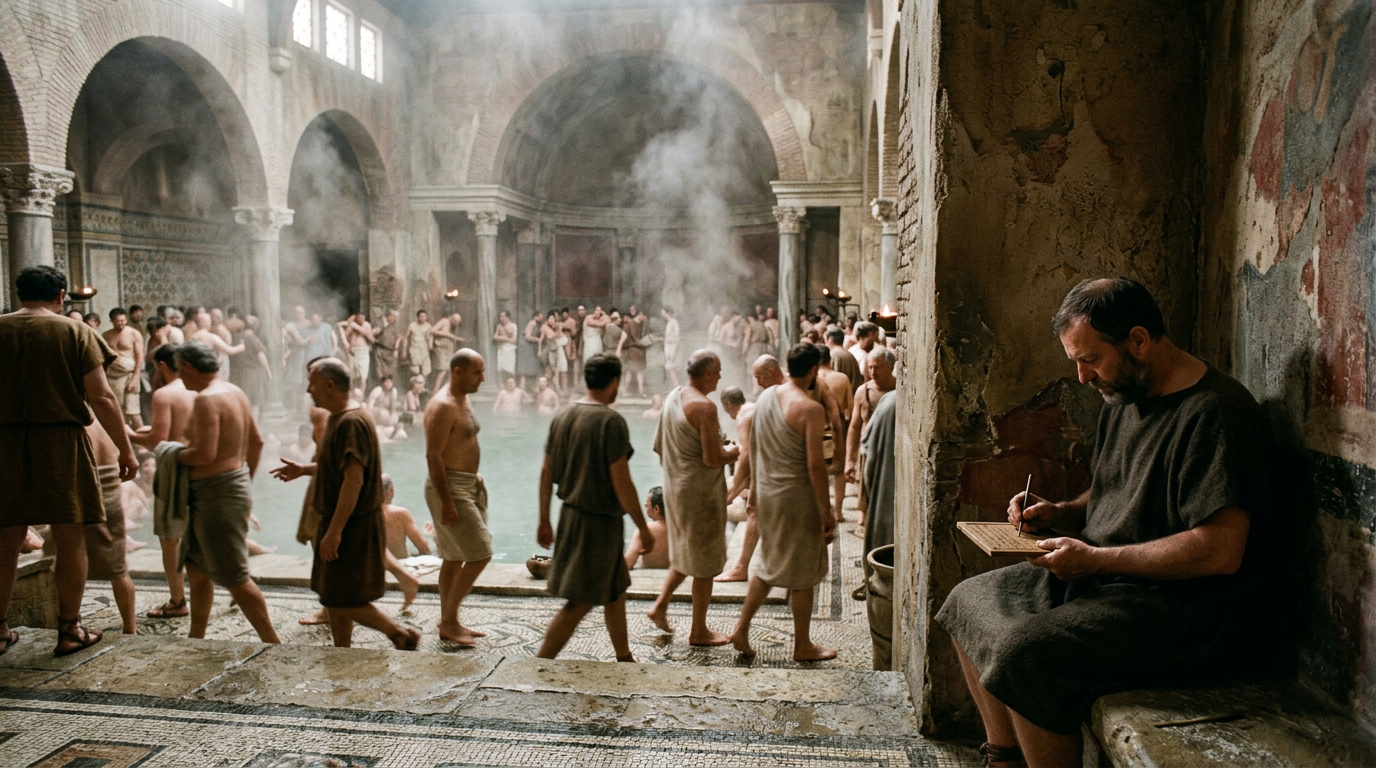
Seneca deliberately went to the noisiest baths in Rome—the Baths of Caracalla. Plucking, massages, boxing, wrestling, shouting. Unbearably loud. But Seneca said: "I find even here that I could think." He sought out the busiest place in Rome to train his focus.
It's not just the physical part we're training. It's the mental part—perhaps more than anything in this noisy, busy, crazy world. Sitting down and focusing for 30 minutes like a Roman might be harder than any workout.
Key Takeaways:
Stop waiting for silence and perfect conditions.
Train focus inside the noise, not in spite of it.
Focus is a muscle. Distraction is the gym.
🔵 Rule 3: Only Compete Where Winning Is Up to You
Epictetus said: "If you want to win, you should only run in races where winning is up to you."
This comes back to what's in your control and what's outside it. Needing to be first, beat others, get the perfect score—or hit the bestseller list—if you're focused on any part that's not up to you, you're vulnerable.
But if your goal is to do your best? To push your limits? To learn something about yourself? Then winning is up to you. You succeed no matter what. Write the best book you can. Grow from the process. Where it hits on the list, how many copies it sells—that's all extra.
Key Takeaways:
Effort, growth, and learning are yours. Outcomes aren't.
Chasing external validation makes you fragile.
Redefine "winning" as something only you control.
🟠 Rule 4: Break Free from the Ambition Trap
In front of the Roman Forum, there are statues of famous emperors—Julius Caesar, Augustus, Trajan. We're told Caesar once saw a statue of Alexander the Great and broke down weeping because Alexander had conquered the world at a younger age than Caesar was in that moment.
But Marcus Aurelius compares Alexander, Caesar, and Pompey to Diogenes, Heraclitus, and Socrates. The philosophers knew the what, the why, and the how. Their minds were their own.
The great generals? He said they knew nothing but anxiety and enslavement.
Seneca said it about Marius: "Marius commanded armies, but ambition commanded Marius." We're all a slave to something.
Key Takeaways:
Achievement without self-ownership is just a prettier cage.
Ambition can command you as easily as any master.
Philosophy gives you the clarity to see what actually matters.

🟣 Rule 5: Stop Living in Pseudo-Reality
When you're watching the game, you're present. You're enjoying it. Watching excellence play out—that's great!
👉🏼 But reading the news the week before about who's hurt, what the plans are, what people are speculating? Nothing you learn is going to change what happens during the game. You're not the GM or the coach or on the field.
Same with elections. Watching every late-breaking development, every gaff, every disaster—all it's doing is making you crazy and not changing the outcome. It's taking you away from your actual family, your actual job, and the things you might do in the real world to bring about that outcome.
Key Takeaways:
Consuming ≠ contributing.
If you can't affect the outcome, stop marinating in it.
Enjoy things—but don't let them replace your real life.
⚫ Rule 6: Hold Everything Loosely—You Only Own It in Trust
A family built a building on Main Street in the 1850s. Their son carried on the business when his father died in 1901. That building has changed hands dozens of times since—which is what happens to all our possessions.
The things you love, the things you care about—eventually someone else is going to possess them. That is, if they don't throw them away.
There's a story about Epictetus. He had a lamp that was stolen. Instead of being upset, he said: "You can only lose what you have."
He replaced it with something cheaper. The lesson isn't that you should never have anything. It's that we only own this stuff in trust. Temporarily. Not just the job. Not just the house. Everything in our life is only ours for as long as we are lucky to have it.
Key Takeaways:
You're not an owner. You're a steward.
Perspective on possessions = peace with loss.
"It's only temporary. We only get it for a little bit."
🔴 Rule 7: Practice Memento Mori—Remember You Are Mortal
The Roman emperor had someone whisper in his ear at his highest moments: "Remember that you are mortal. You are not a god. You are a human being."
Marcus Aurelius: "You could leave life right now. Let that determine what you do and say and think."
We all know we're going to die. Everyone who's ever been born will die. That's the one prophecy that's never failed. Yet the Stoics would say we get it wrong to think of death as this thing in the future—some distant thing that will happen when you're old. It can happen at any moment.
Seneca would say we have to see death as ever-present. Right in the midst of life, we are in death. The time that passes belongs to death. Once time passes, it's dead to us forever.
As we kill time, time kills us. We're dying every minute. We're dying every day. So the reason we have to say no. The reason we have to design our lives. The reason we have to be conscious of where we're going and what we're doing. We don't know how long we have.
Key Takeaways:
Death isn't waiting for you. It's happening now.
Balance the books of life each day.
You could leave life right now. Let that determine what you do and say and think.
❓ Quick Reality Check (Before We Begin)
🔸 You might be thinking: "But I'm not a Roman philosopher. I have a job, kids, real responsibilities. I don't have time to contemplate death all day."
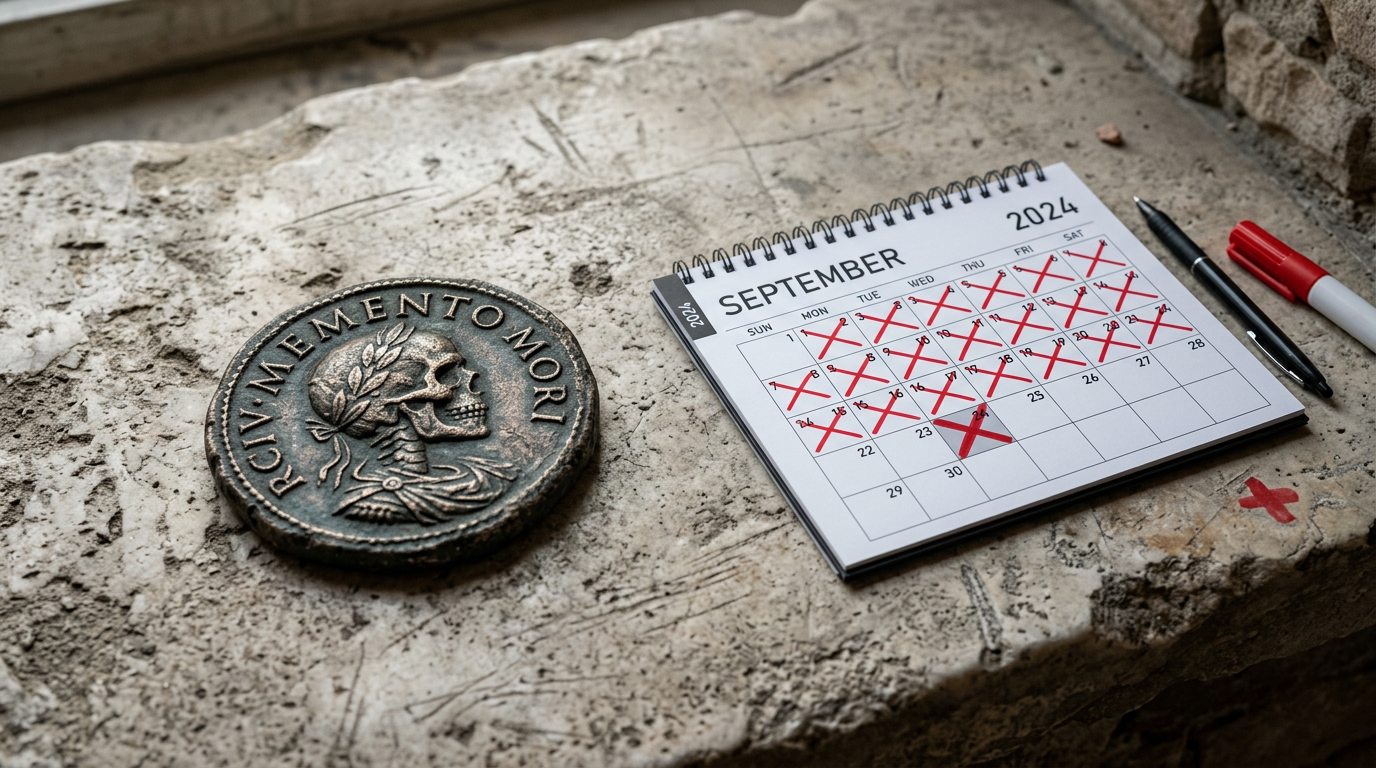
The Truth: This isn't about adding another task to your list. It's about shifting the lens through which you see the time you already have. Memento mori takes seconds—a whispered reminder, a ring on your finger, a single thought before you check your phone.
The Stoics weren't monks. Marcus Aurelius ran an empire. Seneca was one of the wealthiest men in Rome. They were busy. The practice isn't about doing less—it's about doing everything with intention!
🔸 "Does thinking about death constantly just make life depressing?"
The Truth: The Stoics found the opposite. Death awareness isn't morbid—it's clarifying. When you realize you could leave life right now, the trivial stuff falls away. The grudge you're holding? The argument you need to win? The status you're chasing? It all gets quieter.
What remains is what actually matters: your family, your work that makes a difference, your character. Memento mori doesn't make life darker. It makes it sharper.
🚀 The REAP 5-Minute Accountability Reset
This is how we think. This is how we move. This is how we show up! Don't just read this—run one full round right now:
R — Recognize & Run Out (Minutes 1 & 2)
Name one area where you've been living on autopilot—following "wretched habit" without questioning it. Maybe it's the scroll before bed. The second cup of coffee you don't even taste. The workout you skip because you're "too busy."
Fact-check it honestly: has this pattern actually built the life you want, or just given you a false sense of comfort? Pause the old story.
E — Exchange + Envision + Emotion (Minutes 3 & 4)
Exchange your input. Visualize tomorrow morning. Instead of hitting snooze, envision yourself rising on the first alarm. Feel your feet hit the floor. See yourself outside, moving your body before the world wakes up.
Feel the shift from "reacting to my day" to "commanding my day." This is what ruling yourself feels like.
A — Activate with Action (Minute 5)
Write down the one thing you will do tomorrow morning before you touch your phone. Commit to it before the day ends. Put your shoes by the door. Set the alarm. Make it real!
P — Program & Prosper (The Theta Window)
Celebrate tiny wins and lock this in during your neurological goldmine: the first 5–10 minutes after waking, or the last 5–10 before sleep. Stack the Reps!! Presence becomes identity. Identity becomes reality!
(Note on the science: This is the foundation of Hebbian learning—often summarized as "neurons that fire together, wire together." Repeated mental patterns physically strengthen neural pathways, a principle first established by Donald Hebb in 1949 and continuously validated in modern neuroplasticity research.)

💪🏼 Don't You Quit NOW!
If this reset shifted something for you, don't let it fade by noon!
Get tomorrow's Wellness Wednesday Upgrade — Stop Wasting Money On Supplements — A Neuroscientist's Brutal 5-Pill Truth — dropping free at 4:44 AM.
Subscribe now and get instant access to the free 2-Page REAP & Theta Mornings PDF to lock today's framework in for good.
Subscribe free and get the PDF →
🎖️ Tactical Tuesday Upgrade: Tomorrow morning, before you touch your phone, go outside and move your body for 5 minutes. Walk, run, stretch—just own the first moments of your day.
Five minutes. One shift. One upgrade. Stay focused. Keep building!
P.S. — This is how we reach the perfect day. Not all at once. One deposit at a time. One honest pattern at a time. One upgraded morning at a time. See you tomorrow at 4:44 AM.
🌱 Start Here: The Foundation
🔸 Your Genes Are the Blueprint, Your Beliefs Are the Builder: Rewiring Reality Through Epigenetics
The foundation of our biology teaching: how beliefs, environment, and repeated inputs shape the way we live. CLICK HERE →
🔸 The Illusion of Reality: Where Consciousness Research Meets Direct Experience
The beginning of our consciousness and awakening series—an invitation to question the reality you have been handed. CLICK HERE →
💖 This post exists because I believe the best thing I can do for you is bring you the truth — Scientific, Soulful, and Actionable. YOU are why I'm here—so my mistakes and research become your shortcuts!
Pay It Forward! 🚀
~Brett
TheMorningMotivator.com
We're Upgrading 1%+ Every Day! (+34% Monthly, +38% Annually!)
Medical & Training Disclaimer: Hey, I'm just your science-backed, soul-led, unapologetically human mindset & performance trainer. The content provided in this blog post is for educational and informational purposes only. I am not a licensed physician, physical therapist, or medical professional, and this blog is NOT intended as a substitute for qualified medical advice. Always consult your healthcare provider or certified coach before making major life decisions or life changes. Got it? Good. I'll catch you tomorrow. Peace out!


