
The 7-Book Brain Upgrade: Stop Informing. Start Rewiring. | Strategic Sunday

Don't let your learning lead to knowledge. Let your learning lead to action.
The 7-Book Brain Upgrade: Stop Informing. Start Rewiring!
Strategic Sunday
By Brett G Waddell ~TheMorningMotivator.com
Wake Up?
Let me ask you something.
Not the kind of question you answer out loud. The kind that sits with you. The kind that, if you're honest, makes you uncomfortable.
Here it is:
Who built the reality you're living in right now?
Not the physical reality—the mental one. The voice in your head that tells you what's possible. The rules you follow without questioning. The ceiling you don't even know is there because you've been told your whole life it's just... the sky.
Most people never ask that question. They live inside a house they didn't design, following blueprints they never saw, unaware the walls aren't even real.
And here's the part nobody tells you: that's by design.
Not some conspiracy. (Well maybe) Something more subtle. A system. A culture. A thousand tiny inputs from the moment you woke up this morning—notifications, ads, expectations, obligations—all shaping what you think, what you want, who you believe yourself to be.
You're running on software you didn't choose.
Now, I could yell at you about this. I could tell you to wake the f*** up. And some of you need that. But here's what I've learned from doing this work with hundreds of people:
Shock opens the eyes. But it doesn't keep them open.
What keeps them open is this: the slow, uncomfortable realization that you've been carrying something that was never yours to carry.
So here's what I'm offering today. Not a lecture. Not a motivational speech that fades by lunch. The blueprint of the cage you're standing in.
I'm not going to tell you it's a cage. I'm going to hand you the tools to dismantle it yourself. But first, you have to have the courage to look at the blueprint with me.
Most people won't. They prefer the comfort of thinking the bars are there for their protection.
Are you most people?

We live in an age of unprecedented access. You can learn anything. You can read everything. And yet, most people remain exactly where they started. Why? Because we've confused knowing with becoming. You have the opportunity, today... right now, to start becoming.
Are You Ready?
There's a silent war being waged for the real estate between your ears. And you're losing. Not because you're weak. But because you've been handed a map to a battlefield and told it was a meditation app.
The enemy isn't your lack of willpower. It's a system designed to keep you pacified, consuming, and asleep.
I'm here to be your intelligence officer. The intel is ugly.
Ok...
Your Brain, Right Now,
is physically capable of more focus, more resilience, and more authentic power than you have ever allowed it to express.
That's not motivational fluff. That's neuroscience.
But here's the part they don't tell you in the slick, ad-filled podcasts: your brain is also perfectly content to let you rot. It will happily reinforce the neural pathways of anxiety, distraction, and self-doubt—because those pathways are easy.
Comfort is the enemy.
Today, we're burning the comfortable paths and forging new ones.
It's going to hurt.
Let's go.
Awareness Brings Answers.
This is where the work begins. This is where REAP comes in.

Something subtle. A system. A culture. A thousand tiny inputs from the moment you woke up this morning—notifications, ads, expectations, obligations—all shaping what you think, what you want, who you believe yourself to be.
The Problem: The Great Deception of Information
We live in an age of unprecedented access. You can learn anything. You can read everything. And yet, most people remain exactly where they started.
Why?
Because we've confused knowing with becoming.
You can know the science of habit formation and still scroll for three hours. You can know the principles of stoicism and still lose your temper. You can know the secrets of success and still feel stuck.
The problem isn't your knowledge. The problem is your operating system.
Most books will change your speed.
The books we're talking about today will change your engine!
The Scenario: The Wall Street Traders You've Never Heard Of
Imagine you invite 10,000 Wall Street traders to a stadium. They flip a coin. Heads, they double their money. Tails, they go bust and go home.
After one year, 5,000 remain. After two years, 2,500. After five years, 312 traders remain. They won five times in a row.
Now, what happens?
These 312 people will be on the cover of Forbes. They'll write books. They'll sell you systems. They'll start YouTube channels. They'll be celebrated as geniuses.
But here's the chilling question: Are they masters, or are they just lottery winners?
The answer, as the MIT Monk explains in the video, is that you cannot distinguish a master from a lucky idiot simply by looking at their track record.
This isn't just about traders. This is about your life.
How much of your success is actually you—and how much is timing, tailwinds, and randomness you didn't control?
Think about your own wins. Be honest. How many came from skill? How many came from being in the right place at the right time?
We often confuse a tailwind with our own talent.
"We seldom realize that our most private thoughts and emotions are not actually our own. For we think in terms of languages and images which we did not invent, but which were given to us by our society."
— Alan Watts
Watch this video from the MIT Monk. He breaks down the 3-gate filtering system for finding books that actually rewire your brain, then walks through four books that pass every gate. Pay attention to how he talks about the difference between books that change your speed versus books that change your engine.
Powerful insights from the MIT Monk. The 3-gate system—Operator, Challenger, Fire Alarm—is exactly the kind of filter we need to stop wasting time on books that just inform us and start investing in books that transform us.
Now let me show you how to take these insights and make them actionable with the REAP System.
The Science: Why Most Books Don't Change You
Before we go deeper into the four books, I want to expand on something the MIT Monk touched on: why information alone doesn't change you.
There's a principle in neuroscience called Hebb's Law:
"Neurons that fire together, wire together."
When you read a book, you're creating temporary connections in your brain. But unless you reinforce those connections with action, they fade. They're like footprints in sand, washed away by the tide of your daily routine.
The books the MIT Monk shared—Fooled by Randomness,Think Again,Thinking in Bets,The Intelligence Trap, Thinking, Fast and Slow, The Innovator's Dilemma, Superforecasting—are powerful because they target specific failure modes in our thinking.
But here's what I've learned working with clients: reading them isn't enough.
You need a system to integrate them. You need to do the reps.
That's why I created REAP.

When you read a book, you're creating temporary connections in your brain. But unless you reinforce those connections with action, they fade. They're like footprints in sand, washed away by the tide of your daily routine. Enter REAP.
The Core Four (The Toolkit)
1. Fooled by Randomness by Nassim Nicholas Taleb
The Gut Punch
This book forces you to ask: Are my heroes visionaries or just lottery winners? Taleb shows why randomness manufactures geniuses and why you cannot distinguish a master from a lucky idiot simply by looking at their track record.
Key Concept: Survivorship bias. We often confuse a tailwind with our own talent.
2. Think Again by Adam Grant
The Proficiency Prison
The smarter you are, the harder it is to change your mind. When you win, you stop searching and start defending what you already know. The more you know, the less you see.
Key Concept: The Preacher, Prosecutor, and Politician masks—and how to replace them with the Scientist mindset.
3. Thinking in Bets by Annie Duke
Decision-Making Under Uncertainty
Treat every decision like a bet. Know exactly what's at risk and whether you have a plan to manage that risk. Stop reacting and start revising.
Key Concept: Decision journals, probabilistic thinking, and separating outcome quality from decision quality.
4. The Intelligence Trap by David Robson
The Most Dangerous Book on the List
What if your intelligence itself is the trap? Smart people have a special failure mode: they can rationalize anything. Most people hit a wall and question themselves. Smart people hit a wall and question the wall.
Key Concept: The anti-mentor, the empty cup, andShoshin(the beginner's mind).
The Graduate Level (The Deep Dives)
5. Thinking, Fast and Slow by Daniel Kahneman
The Wiring
A Nobel Prize winner's masterwork showing exactly what's happening in your brain. System 1 makes you jump to conclusions immediately. System 2 helps you avoid those mistakes—if you engage it. This book reveals the cognitive machinery behind why we get fooled.
6. The Innovator's Dilemma by Clayton Christensen
Why Success Fails
The classic explanation of why successful companies get disrupted. They do everything right—listening to customers, protecting their core business—and still die. Intel dominated chips but missed GPUs. Kodak invented digital photography but buried it. This book shows you how to avoid the same trap.
7. Superforecasting by Philip Tetlock
The Art of Probabilistic Thinking
Based on decades of research studying 25,000 predictions, Tetlock reveals how the world's most accurate forecasters think. They don't think in yes/no terms. They think in bets, odds, and probabilities—and they update their numbers every time new data arrives. They aren't trying to be right all the time; they're trying to beless wrongafter every iteration.
These books, as the MIT Monk explains, will change your engine—not just your speed.
But again: reading them isn't enough. You need to do the work.
That's where REAP comes in.
The REAP Solution
Let me introduce you to the framework I use personally and with my one-on-one clients. I call it REAP.
It's designed to take insights—from books, from videos, from life—and turn them into lasting change.
R — Recognize & Run Out
This is where it starts. You can't change what you don't see.
When you read a book like Fooled by Randomness, the first step is simply to notice. Notice where you've been confusing luck with skill. Notice the stories your mind tells you about your success. Notice without judgment.
"To have faith is to trust yourself to the water. When you swim you don't grab hold of the water, because if you do you will sink and drown. Instead you relax, and float."
— Alan Watts
First, you have to see how you're swimming.

"You're under no obligation to be the same person you were 5 minutes ago."
E — Exchange & Envision
Once you see the old thought, you get to choose a new one. Not by force. By replacement.
What would you rather believe? What does the person who has integrated these books believe about themselves?
For Think Again, maybe you exchange "I need to be right" for "I need to be curious." For The Intelligence Trap, maybe you exchange "I already know" for "What am I missing?"
You don't have to fully believe it yet. Just practice saying it. Just practice feeling it.
"You're under no obligation to be the same person you were 5 minutes ago."
— Alan Watts
A — Activate With Action
One small action. That's it.
Not the whole staircase. Just one step.
The person you want to become would do one thing differently today. What is it?
Maybe for Thinking in Bets, they'd write down their confidence level before a decision. Maybe for Fooled by Randomness, they'd do a Luck/Labor Audit. Maybe for The Intelligence Trap, they'd ask a naive question they're embarrassed to ask.
Do that.
"Success is not something you pursue. Success is something you attract by becoming the person who deserves it."
— Jim Rohn
You don't chase the upgrade. You become the person who has been upgraded. The upgrade follows.
P — Program & Prosper
Do this tomorrow. And the next day. And the next.
Day after day. Rep after rep.
"Neurons that fire together, wire together."
— Donald Hebb, 1949
You're not building a new life. You're building a new pattern. The life follows.
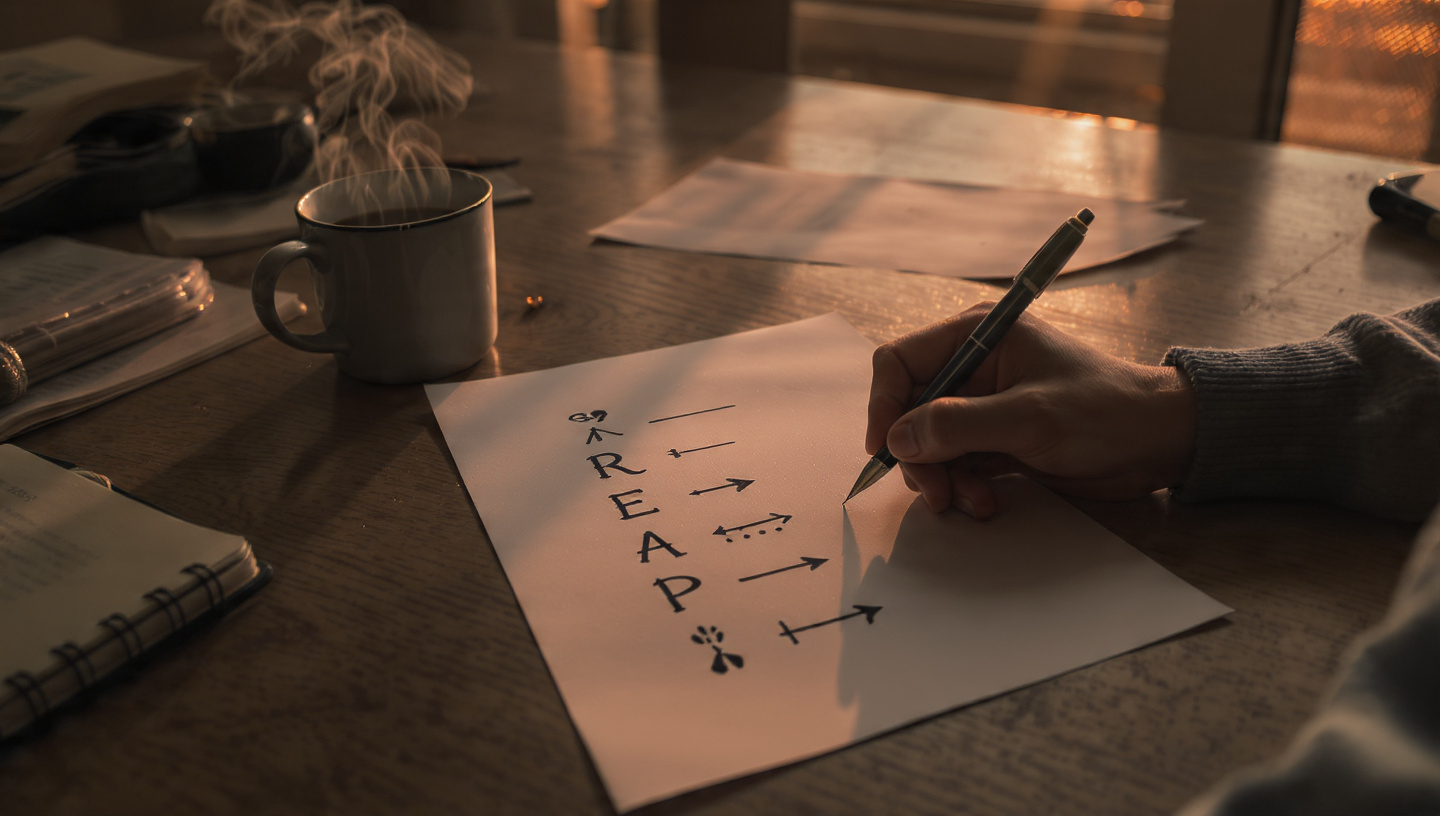
You don't chase the upgrade. You become the person who has been upgraded. The upgrade follows.
But Here's What Most People Miss
The REAP framework only works if you actually do it. And let's be honest—by midday, the world has already voted. The notifications have flooded in. The emergencies have piled up. Your good intentions get buried under everyone else's agenda.
So when do you get your first reps in?
Before the world gets its vote.
The Critical Window: Your First 5 Minutes
Here's something most people don't know—and it might be the most important thing you read today.
It all starts in the first 5 minutes!
The moment you open your eyes, your brain is producing theta waves—that hypnagogic state between sleep and waking where your subconscious is wide open. Your mind is literally twice as suggestible as it will be just 15 minutes from now.
This is where REAP Reps become automatic. This is where programming happens without friction.
This is why I created The 5-Minute Theta Morning Routine.
No decisions. No willpower required. Just open, read, follow the instructions, and let the reprogramming sink in before the world gets its claws in you.
Your 5-Minute Micro-Action Plan
Starting NOW: DO IT!
Minute 1: Take three deep breaths. Relax.
Minute 2: Ask yourself: "Who do I need to become today to attract the success I want?"
Minute 3: Visualize yourself as that person. See it. Feel it.
Minute 4: Choose ONE action that person would take today.
Minute 5: Commit. Out loud if possible. "I am becoming the person who attracts success."
That's it. Five minutes. One REAP Rep completed.

This is how we reach the perfect day. Not all at once. One deposit at a time. One pillar at a time. One morning at a time. One moment at a time.
FAQ: Your Questions Answered
Q: I've already read some of these books. Do I need to read them again?
A: Not necessarily. But ask yourself: did you just read them, or did you integrate them? The MIT Monk's video helps you identify the books. REAP helps you do the integration. If you haven't taken action on what you read, the information hasn't served you.
Pick one insight from each book and run it through the REAP framework this week.
Q: How is this different from other personal development content?
A: Most personal development focuses on tactics—habit hacks, productivity tips, mindset tricks. That's all speed. REAP is about changing your engine. The books the MIT Monk shares target the fundamental ways your brain fails you: randomness, certainty, outcome bias, and rationalization.
REAP gives you a system to rewire those patterns at the neurological level.
Q: What if I don't have time for all four books right now?
A: Then don't read them all. Pick one. Run it through REAP. Do the reps. The MIT Monk's 3-gate system is brilliant for this—let it guide you to the book that addresses your biggest failure mode right now. Is randomness fooling you? Are you trapped in certainty? Do you need to think in bets? Are you rationalizing your way into mistakes? Start there.
The Deeper Lesson: The Dark Tunnel
There's something the MIT Monk shared at the end of his video that I can't stop thinking about.
He talked about riding a train with his young kids. The train went through a dark tunnel under the river. The kids—seven and four—were overwhelmed with joy. They giggled. They pressed their faces to the glass. They saw magic!!
He took that same tunnel twice a day. And never once felt that wonder.
As we grow old, why do we treat our sense of wonder as weakness? Why treat our curiosity as if it's a curse?
The books he shared—and the REAP framework I've given you—will help you reset your system. But the ultimate system upgrade isn't adding more to your cup.
✨ It's your ability to go through the dark tunnel and still find magic in it.
That's the upgrade. That's the point of all of this. Not to know more. Not to be smarter. But to see more clearly. To experience more fully. To move through life with beginner's mind—empty cup, ready to receive.

"We must all suffer from one of two pains: the pain of discipline or the pain of regret. The difference is discipline weighs ounces while regret weighs tons. Motivation is what gets you started. Habit is what keeps you going." ~ Jim Rohn
Your Move
I've given you the MIT Monk's insights. I've given you the REAP framework. I've given you the five-minute action plan.
Now it's your turn.
Here's what I need you to do right now:
1. Watch the video. Scroll up and watch the MIT Monk's video. Let his words sink in. Hear the 3-gate system from him directly.
2. Download your free 5-Minute Theta Mornings PDF. This is a done-for-you morning protocol that walks you through those critical first five minutes. No decisions. No willpower required. Just open, read, and let the reprogramming sink in before the world gets its claws in you.
3. Share this post. Tag someone who needs to hear this. Send it to a friend who's been fighting for their limitations. Change starts with us.
SIGN UP HERE to get your Masterclass blog post link at 5:00 AM CST and download your free 5-Minute Theta Mornings right now!
Start tomorrow. Five minutes. One REP.
"You're under no obligation to be the same person you were 5 minutes ago."
— Alan Watts
Decide. The rest is downhill.
Stay Focused.
Keep Asking Better Questions!
P.S. — This is how we reach the perfect day. Not all at once. One deposit at a time. One pillar at a time. One morning at a time. See you tomorrow at 4:44 AM.
Hey, I’m just your science-backed, soul-led, unapologetically human, mindset & motivation trainer. The content provided in this blog post is for educational and informational purposes only. I am not a licensed therapist, and this blog is NOT intended as a substitute for the advice of a physician, psychotherapist, or other qualified professional. Got it? Good. I’ll catch you tomorrow.
Pay It Forward! 🚀
~Brett
TheMorningMotivator.com · CompleteBusinessFitness.com
You’re Upgrading 1%+ Every Day! Keep Going! = +34% Monthly, +38% Better Annually!


