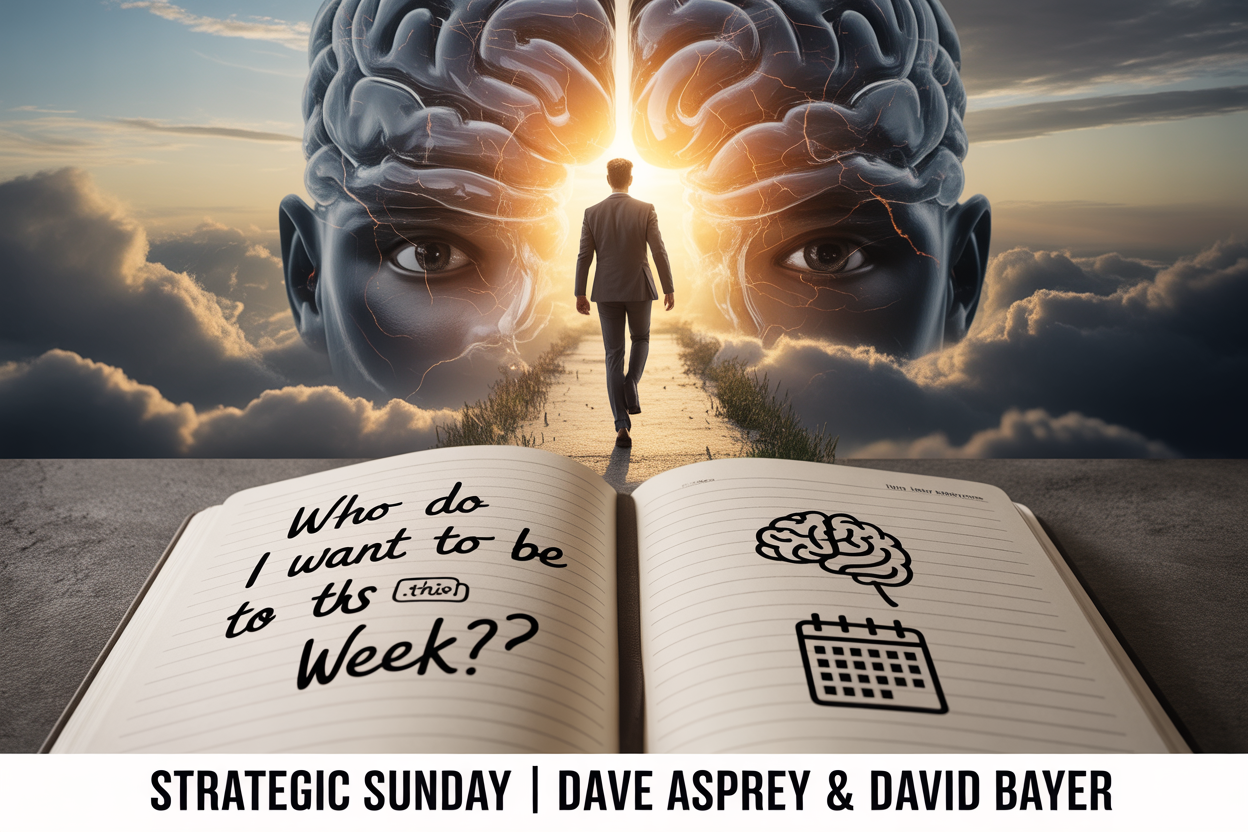
How to Outsmart Reality: Dave Asprey & David Bayer | Strategic Sunday

Strategic Sunday is your reset. Not to hype yourself up. But to choose who you are before the week chooses for you!
Setting Your Weekly Intention: “Who Do I Want to Be This Week?” (How to Outsmart the Reality Game You’ve Been Playing Wrong)
This pattern—where motivation fades by Tuesday—is exactly what Dave Asprey and David Bayer dismantle in their conversation on How to Outsmart the Reality Game. Video below. Their core thesis:
"You’re not playing the game wrong; you’re playing the wrong game entirely!"
Engaging Real-Life Scenario
It’s Monday morning. You wake up with that familiar mix of pressure and possibility.
You open your calendar. Meetings. Deadlines. Family logistics. A workout you hope happens. A healthy dinner you plan to cook. A promise to “be more focused” that already feels like it’s slipping.
By Tuesday, the week is running you.
Not because you’re lazy. Not because you “lack discipline.” But because you started the week from the wrong place: you started with tasks instead of identity.
Most people set weekly goals like this:
“I’m going to be more productive.”
“I’ll stop procrastinating.”
“I’ll finally get consistent.”
And then they rely on motivation—the most unreliable fuel source on earth.
Strategic Sunday is your reset. Not to hype yourself up. But to choose who you are before the week chooses for you.

Relevant Quote
“Your week doesn’t start with what you do. It starts with who you decide to be.”
— Strategic Sunday
In this episode, Dave Asprey (biohacking pioneer) sits down with David Bayer, host of A Changed Mindpodcast (1M+ monthly listeners) and author of the book that’s rewired tens of thousands of lives.
They break down why motivation is just a microdose of transformation—and how to rewire your beliefs, perception, and biology for sustainable change. Watch now or bookmark!
Notice what stood out: not another hack, not another to-do list—but a deeper lever. The lever is identity, belief, and the emotional pattern you practice until it becomes automatic.
Explanation of the Core Concept
Here’s the uncomfortable truth: motivation is a microdose of transformation. It can spark action, but it can’t sustain a new life.
Sustainable change usually comes from a different sequence:
Belief (what you assume is true about yourself and the world)
Emotion (what your body learns to expect)
Perception (what you notice, focus on, and interpret as “reality”)
Behavior (what you do on repeat)
Results (the life you call “just how it is”)
If you only try to change behavior (“This week I’ll work harder”), you’re playing from the bottom of the stack.
To “outsmart the reality game,” you play higher up:
You choose a weekly identity (“I am the kind of person who follows through.”)
You practice the emotional state that identity lives in (calm, decisive, grounded)
You shape your perception so your brain filters for evidence that supports the new identity
Your actions start matching it because they feel congruent, not forced
This isn’t about pretending. It’s about training your nervous system and attention like you’d train a muscle—through repetition!!
Your brain is constantly updating based on what you repeatedly think, feel, and do. That’s why your “weekly intention” isn’t a cute journal prompt. It’s a programming decision.

This isn’t about pretending. It’s about training your nervous system and attention like you’d train a muscle—through repetition!!
Practical Application: How to Set a Weekly Intention That Actually Works
Most weekly planning starts with: “What do I need to get done?”
Strategic Sunday starts with a more powerful question:
“Who do I want to be this week?”
Not your fantasy self. Your practicable self.
Pick one identity that would make everything else easier. Examples:
“I’m a person who keeps promises to myself.”
“I’m a calm leader under pressure.”
“I’m someone who tells the truth quickly.”
“I’m a creator who ships.”
“I’m a healthy person who moves daily.”
Then you lock it in using three anchors:
1) Evidence (Belief Anchor)
Write 3 proof points—real moments from your life—that this identity is already truesometimes.
Even tiny examples count. This prevents the brain from rejecting the identity as “fake.”
2) Rules of engagement (Behavior Anchor)
Create 2–3 simple rules that make the identity real.
Calm leader → “I pause before I reply.” / “I don’t send heated messages.”
Creator who ships → “I publish before I perfect.” / “30 minutes creating before consuming.”
3) Non-negotiable emotional practice (State Anchor)
Pick one daily practice that trains the emotional state behind the identity:
90 seconds of slow breathing before work
A 10-minute walk without your phone
A 5-line evening journal to close loops
A forgiveness or self-compassion prompt if you’re carrying old weight
✨Because here’s the twist: your identity is glued to an emotional pattern.
If you keep practicing the old emotional pattern (rush, guilt, resentment, shutdown), you’ll keep recreating the old week—even with a new planner.

Do this right now. Set a timer for five minutes.
5-Minute Action Plan
Do this right now. Set a timer for five minutes.
Minute 1: Choose the identity
Finish this sentence:
“This week, I am the kind of person who __________.”
Minute 2: Define the win
Write one line:
“If I live this identity, Friday will feel like __________.”
(Examples: “clean,” “peaceful,” “handled,” “proud,” “lighter.”)
Minute 3: Pick 2 rules
Write two simple behaviors that prove the identity:
Rule #1: __________________
Rule #2: __________________
Make them so easy you can do them on a chaotic day.
Minute 4: Install a daily reset
Choose one “state practice” you’ll do daily (2–10 minutes).
Write it down and decidewhenit happens.
Minute 5: Name your resistance plan
Finish:
“When I feel resistance this week, I will __________ instead of __________.”
Examples:
“breathe for 60 seconds instead of scrolling”
“write the messy first draft instead of reorganizing my notes”
“tell the truth instead of hinting”

A weekly intention is a way of being that produces better outcomes.
Short FAQ
1) What if I don’t know who I want to be this week?
Pick the identity that would reduce the most friction. A reliable default is:
“I’m the kind of person who keeps small promises to myself.”
You can’t build a bigger life on a foundation you don’t trust.
2) How is a weekly intention different from a goal?
A goal is an outcome. A weekly intention is a way of being that produces better outcomes.
You can hit goals while feeling chaotic and depleted. Intentions train the person who can repeat success without burnout.
3) What if I “fail” midweek?
Treat it like data, not a verdict. Ask:
“What identity did I default to?”
“What emotion was I avoiding?”
“What’s the smallest action that returns me to the intention today?”
Then return immediately. The comeback is the practice.
4) Who are Dave Asprey and David Bayer?
Dave Asprey is the founder of biohacking and Upgrade Labs; David Bayer is a top personal growth teacher blending neuroscience, psychology, and consciousness. Together, they map how belief and biology create your reality.
🚀 Ready to Stop Reading and Start Doing?
Knowledge is power, but implementation is everything. Don't let this momentum fade.
Get my free "Morning Momentum Toolkit" – the exact checklist and resources I used to transform my introverted existence into The Morning Motivator with Brett!
👉 Click Here to Get Instant Access to the Toolkit
Hey, I’m just your motivational friend. I am not a licensed therapist, and this blog is NOT intended as a substitute for the advice of a physician, professional coach, psychotherapist, or other qualified professional. Got it? Good. I’ll catch you tomorrow.
Pay It Forward! 🚀
~Brett
TheMorningMotivator.com · CompleteBusinessFitness.com
You’re Upgrading 1%+ Every Day! Keep Going!
Start Here (best next step):
Morning Toolkit: Kickstart your day with my core tools and prompts – your best “Day One” starting point.
Daily Support & Focus:
Daily Upgrades (Free): Get short daily emails + a 5-minute Theta Routine to rewire your mindset and momentum.
Simplify Your Business Workflow:
Two-Tool Business Blueprint (Free Download): See exactly how I use AI + automation to streamline content and tasks.
Quick Clarity in 30 Seconds:
Freedom Blocker Quiz: Find the #1 mindset block keeping you stuck.
Success Blocker Quiz: Reveal your biggest business bottleneck and where to focus next.
This post contains affiliate links. If you buy through these links, I may earn a commission at no extra cost to you. Thanks for reading and supporting the work!


