Wellness Wednesday: Is Social Media Making Us Lonely? Blue Zones Show the Fix

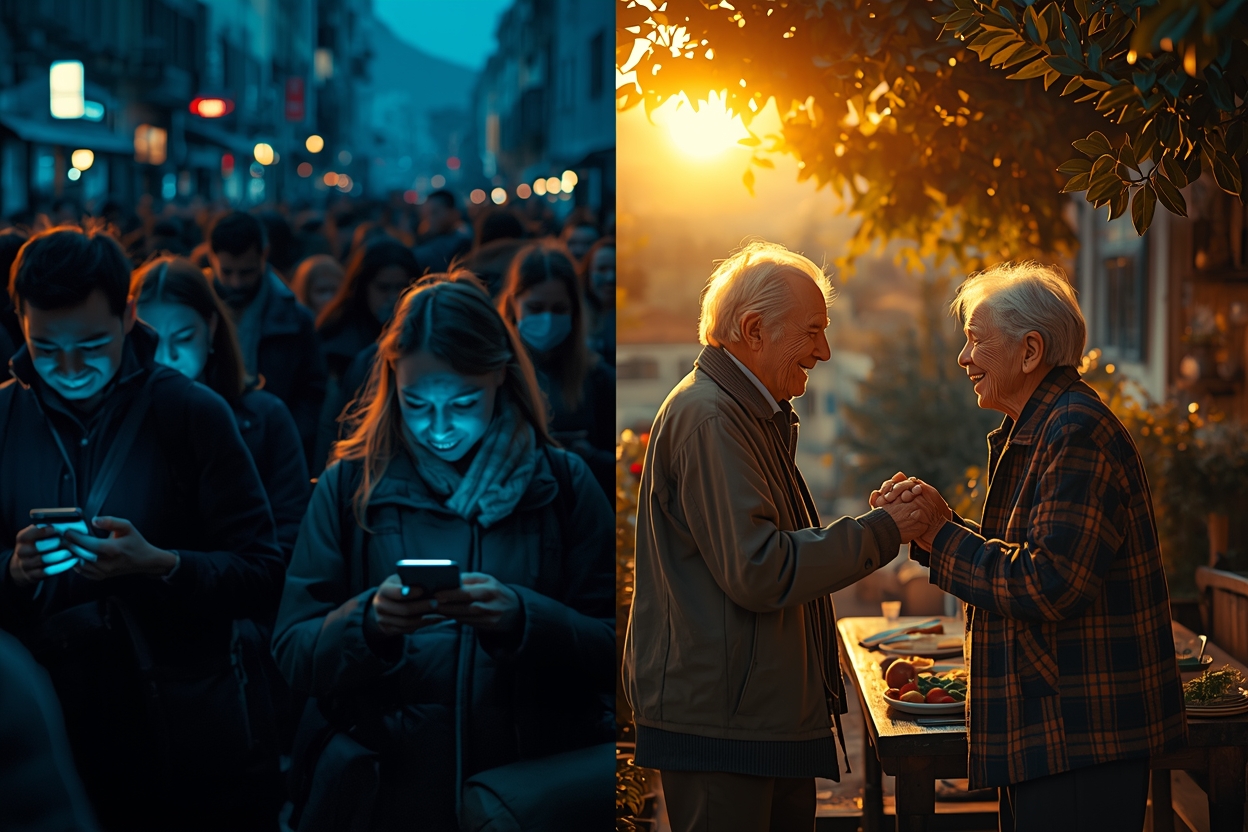
Why is everyone on their phones?
What the Hell is Up With Social? Why Our "Connections" Are Making Us Lonelier—And How to Fix It
We live in an era where we have never been more "connected," yet human longevity and mental well-being are hitting a terrifying wall. If you’ve taken a break from the digital world recently and stepped back in, you know exactly what I’m talking about. The landscape has changed, and frankly, it’s getting weird.
I’ve been off social media for a few years. When I finally came back, I was immediately bombarded with friend requests from Lord knows who. People I’ve never met, people I have no shared history with, and people who have no idea what my morals or values are.
It made me stop and think: What the hell is up with social?
Being "social" has gone in a direction that makes zero sense to me. You want to be my friend? Why? Do you know me? Do you know what I think about, what I talk about, or what I do every day? What I ache for and dream of every waking moment?
In the digital world, we’ve traded the depth of human character for the breadth of a follower count. And if we look at the science of longevity—specifically the lessons from the world’s Blue Zones—this digital shift isn’t just annoying; it might actually be shortening our lives.
The "Creeper" Test: Online vs. Reality
Imagine this: You’re walking down a sunny street, minding your own business. A stranger walks up to you, stands six inches from your face, and says,"Will you be my friend? Also, here is a photo of what I ate for lunch and a video of me dancing in my kitchen."
You wouldn’t say "Accept." You’d probably think they were a creeper and call the cops.
Yet, on social platforms, we’ve normalized this behavior. We’ve accepted a version of "friendship" that requires zero skin in the game, zero eye contact, and zero shared values.
Even worse, this digital "closeness" is bleeding into our physical reality. When I’m out in public now, more than half the time, the person approaching me never even makes eye contact.
They are tethered to a screen, scrolling through the lives of strangers while ignoring the living, breathing human beings right in front of them.
Do you normally make eye contact and say hello? I do. But in today’s world, that basic human gesture is becoming a lost art.

"The quality of your social life is a bigger predictor of how long you will live than even your diet or exercise habits."— Dan Buettner, Blue Zones Researcher
The Blue Zone Connection: Why Real Socializing Matters
If we want to understand why our current "social" habits are so broken, we have to look at the people who are doing it right.
In the Netflix documentary Live to 100: Secrets of the Blue Zones, we see the lifestyles of people in places like Okinawa, Japan, and Sardinia, Italy, where reaching age 100 isn't a miracle—it’s the norm.
One of the "Power 9" principles of longevity is the "Right Tribe." The world’s longest-lived people are born into or choose social circles that support healthy behaviors.
They don’t have 5,000 "friends" they’ve never met. They have a "Moai"—a small, committed group of friends who provide social, financial, health, and spiritual support for a lifetime.
Before we dive deeper, watch this trailer for "Live to 100." Pay close attention to how these centenarians interact. Notice the eye contact, the physical touch, and the genuine laughter. This is what social health actually looks like.
Did you see it? None of those people were looking at a "feed." They were looking at each other. They weren't "requesting" friendship; they were living it. That is the biological gold standard for human connection.
The Science of the "Stare": Why Eye Contact is Dying
When we skip eye contact in the real world to check a notification, we are depriving our brains of a vital chemical cocktail. Real-world socialization triggers the release of oxytocin (the "bonding hormone") and reduces cortisol (the "stress hormone").
Digital interaction, by contrast, often triggers dopamine—the "reward" chemical associated with addiction. We get a hit when we see a "like," but we don't get the long-term health benefits of a real bond.
This is why you can spend four hours on social media and end up feeling more drained and lonely than when you started.

The "Blue Zone" residents don't just "connect"; they commune. They drink wine together, they garden together, and they look each other in the eye. They know each other's morals. They know each other's families.
When you bypass the "knowing" part of a relationship to jump straight to the "friend" status on an app, you aren't building a Blue Zone life—you're building a digital facade.
How to Reclaim Your "Social" Health
If we want to live long, vibrant lives, we have to stop treating social media as a substitute for social connection.
It’s time to bring the Blue Zone mindset back to our modern streets. We need to stop being "creepers" online and start being "neighbors" offline.
Practical Application: The "Real-World First" Rule
Audit Your Circle: If you wouldn’t let them into your living room, why are they in your "friends" list?
The "Eye Contact" Challenge: Next time you’re walking down the street, put the phone in your pocket. Look people in the eye. Say "Good morning."
Values over Views: Seek out people who share your morals and values in physical spaces—clubs, gyms, churches, or volunteer groups.

Your 5-Minute Wellness Wednesday Action Plan
You don’t need to move to Okinawa to start living like a centenarian. You can start right now with these three steps:
The Unfollow Flush (2 Minutes): Go to your most-used social app. Scroll through your recent "friend requests" or followers. If you don't know their values, hit "Delete." Clear the noise.
The Proactive Hello (1 Minute): Text one person you actually know and care about. Don't "like" their post; ask them when they are free for a coffee or a walk.
The "Screen-Down" Commitment (2 Minutes): Commit to keeping your phone in your pocket for the next transition you have today (walking to your car, waiting in line, or entering a building). Practice making eye contact with three people.
Frequently Asked Questions
Q: Is it bad to have online friends?
A: Not at all!! Online communities can be great. The problem arises when we prioritize the quantity of shallow online connections over the quality of deep, real-world interactions. Use social media as a tool to organize real life, not as a replacement for it.
Q: Why does eye contact feel so awkward now?
A: Because social skills are like muscles—if you don't use them, they atrophy. We've spent a decade training our brains to look at screens. It feels "weird" because it’s becoming unfamiliar, but it’s actually our natural biological state.
Q: How do the Blue Zones handle technology?
A: Many centenarians in Blue Zones have limited access to modern social media, but even those who do use tech prioritize the "Moai" (the village) first. Technology is a peripheral tool for them, not the center of their social universe.

Final Thoughts: Let’s Go Deeper
It’s time to ask ourselves: Does anybody out there really think this digital-first lifestyle is healthy? The data says no. Our intuition says no.
If we want to live to 100, we need to stop clicking "Accept" on strangers and start clicking "Play" on our real lives. Make eye contact. Say hello. Know who your friends are—not just their usernames, but their souls.
Happy Wellness Wednesday! Now, put down the phone and go find your tribe!
🎯Daily Upgrades (Free): Get short daily emails + a 5-minute Theta Routine to rewire your mindset and momentum! Free daily email. Real solutions. No fluff.
Pay It Forward! 🚀
~Brett
TheMorningMotivator.com · CompleteBusinessFitness.com
You’re Upgrading 1%+ Every Day! Keep Going!
Start Here (best next step):
Morning Toolkit: Kickstart your day with my core tools and prompts – your best “Day One” starting point.
Daily Support & Focus:
Daily Upgrades (Free): Get short daily emails + a 5-minute Theta Routine to rewire your mindset and momentum.
Simplify Your Business Workflow:
Two-Tool Business Blueprint (Free Download): See exactly how I use AI + automation to streamline content and tasks.
Quick Clarity in 30 Seconds:
Freedom Blocker Quiz: Find the #1 mindset block keeping you stuck.
Success Blocker Quiz: Reveal your biggest business bottleneck and where to focus next.
This post contains affiliate links. If you buy through these links, I may earn a commission at no extra cost to you. Thanks for reading and supporting the work!


