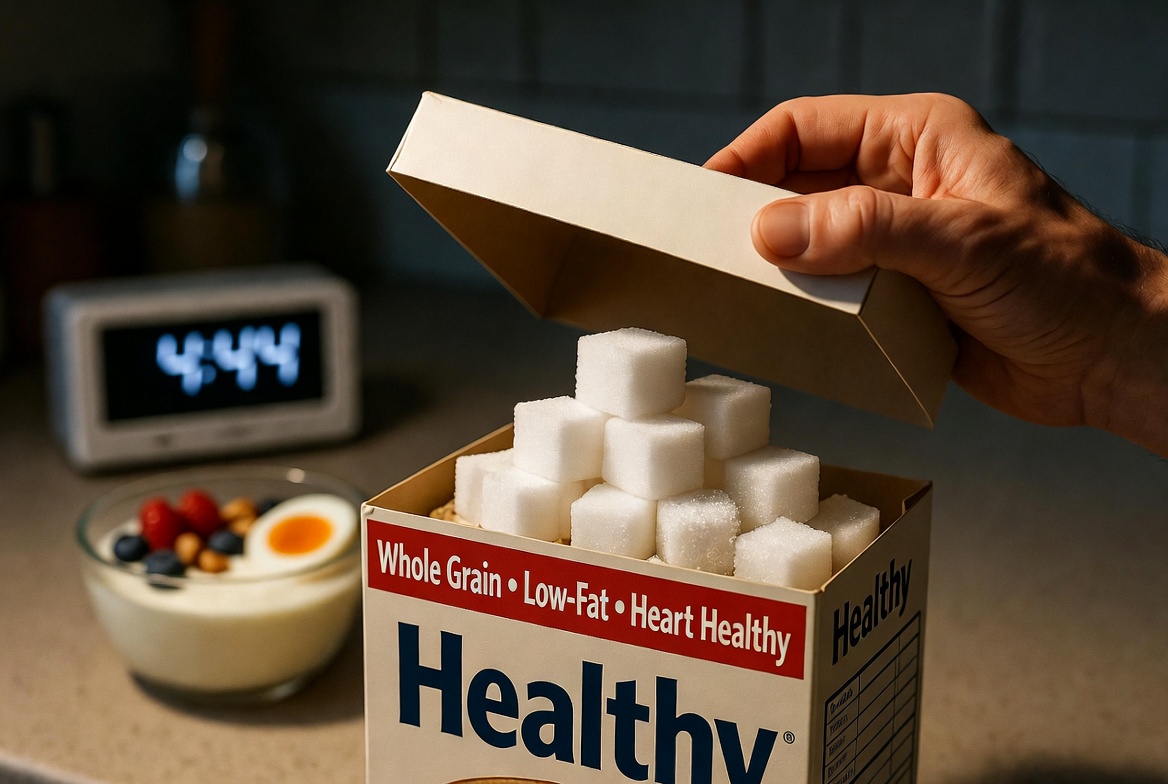
Wellness Wednesday: The Sugar Lie – How "Healthy" Food Hijacks Your Brain

According to Dr. Robert Lustig, one of the world’s top researchers on sugar, metabolism, and addiction, the real problem isn’t your willpower. It’s that you’ve been systematically lied to about what “healthy” food actually is.
The Sugar Lie: What the #1 Expert Says About “Healthy” Food!
You wake up determined to “eat clean.”
You pour the “heart-healthy” whole‑grain cereal.
You add low‑fat yogurt.
You grab a protein bar labeled “no high-fructose corn syrup” for later.
By 10:30 a.m., you’re exhausted, hungry again, and craving something sweet.
By evening, you’re beating yourself up: “What’s wrong with my willpower?”
According to Dr. Robert Lustig, one of the world’s top researchers on sugar, metabolism, and addiction, the real problem isn’t your willpower. It’s that you’ve been systematically lied to about what “healthy” food actually is.
Welcome to Wellness Wednesday. I’m Brett, your Morning Motivator. Today we’re pulling back the curtain on the sugar lie hiding in your pantry—and what you can do about it in just five minutes. (Yes Sugar)
Your science-backed-solution!
“Healthy” Food That Quietly Breaks Your Brain
Walk down any supermarket aisle and you’ll see:
“Low-fat” yogurt
“Whole-grain” bread
“No added sugar” cereal
“Heart healthy” granola bars
💠 Most of these products share three traits:
Ultra‑processed
Loaded with added or refined sugar
Marketed as “healthy” or “guilt-free”
Dr. Robert Lustig, a neuroendocrinologist who’s spent decades studying sugar, addiction, and obesity, puts it bluntly:
“Sugar has become the most overexposed and least understood ingredient in our entire food supply.” – Dr. Robert Lustig
And here’s the part almost no label tells you:
Sugar isn’t just about weight gain
It rewires your brain’s reward system
It damages your liver, gut, and metabolism
It increases your risk of depression, dementia, and chronic disease
We’ve been told to count calories, go low‑fat, and trust the front of the package.
But the science says: it’s the quality of the calories—and especially the sugar—that matters most.
In this powerful conversation, Dr. Robert Lustig breaks down how sugar, ultra‑processed food, and “diet” products hijack your brain chemistry, fuel addiction, and drive today’s biggest health crises.
After you watch, scroll back here and use the 5‑minute Sugar Audit below to expose the “healthy” foods in your own kitchen—and upgrade your brain and body starting today.
The Core Concept: Why Sugar in “Healthy” Food Is So Dangerous
Not all sugar is created equal.
Sugar in whole foods (like fruit or plain yogurt) comes packaged with fiber, water, and nutrients. Your body absorbs it slowly, your liver can handle it, and your blood sugar rises more gently.
Added sugar and refined starches in ultra‑processed foods hit your system fast and hard, spiking blood sugar, insulin, and dopamine in your brain.

Lustig’s work and other large studies suggest that most Alzheimer’s risk is environmental, not genetic—and diet is a major player.
Here’s what the science—and Lustig’s research—shows happens when you live on “healthy” processed food:
Dopamine spikes → cravings and addiction-like behavior
Sugar lights up the brain’s reward center, releasing dopamine—the “want more” chemical. Over time, your brain adapts, so you need more sugar to get the same feeling. That’s the beginning of tolerance and dependency.Liver overload → insulin resistance
Fructose (one of the main sugars in many sweeteners) is processed in your liver. In high amounts—especially in sodas, juices, and sweetened “health” foods—it turns into fat inside your liver. This can lead to:Non‑alcoholic fatty liver disease
Insulin resistance (a root cause of type 2 diabetes)
Chronic inflammation
Inflamed brain → low mood, brain fog, and dementia risk
Chronically high sugar and ultra‑processed food intake is linked in studies to:Higher rates of depression and anxiety
Worse memory and focus
Increased risk for cognitive decline and dementia
💠Lustig’s work and other large studies suggest that most Alzheimer’s risk is environmental, not genetic—and diet is a major player.
Stress + sugar = the perfect storm
Modern life keeps our stress hormone cortisol elevated. Ultra‑processed foods temporarily numb that stress with dopamine hits—but at the cost of more inflammation, more fat storage, and more brain damage over time.
The bottom line:
Your “healthy” granola, cereal, yogurt, and protein bars may be training your brain and body for addiction, depression, and disease—even if you’re staying “within your calories.”

Sugar lights up the brain’s reward center, releasing dopamine—the “want more” chemical. Over time, your brain adapts, so you need more sugar to get the same feeling. That’s the beginning of tolerance and dependency. (Sounds like an illegal substance.)
How to Spot the Sugar Lie in Your Kitchen
You don’t need a PhD to outsmart food marketing. You just need a simple system.
1. Ignore the front of the package
The phrases “low-fat,” “whole grain,” “made with real fruit,” “no added sugar,” “high protein” are marketing tools, not health guarantees.
The real truth is on the back.
2. Go straight to the ingredient list
Look for these common sugar clues (there are over 60 names):
Sugar, cane sugar, raw sugar
High‑fructose corn syrup, corn syrup solids
Brown rice syrup, agave, honey
Fruit juice concentrate, evaporated cane juice
Maltose, dextrose, sucrose, fructose
If sugar (or any of its aliases) is in the first three ingredients, you’re looking at a dessert in disguise.
3. Check “Added Sugars” on the Nutrition Facts label
A quick rule of thumb:
0–4 grams per serving: low
5–9 grams per serving: moderate
10+ grams per serving: high
(Remember: 4 grams of sugar ≈ 1 teaspoon.)
That “healthy” yogurt with 18 grams of sugar?
That’s over 4 teaspoons—in one small cup.
4. Use the Fiber-to-Sugar Rule
For packaged carbs (cereal, bars, breads):
Aim for more fiber grams than sugar grams per serving.
Example: 5g fiber and 3g sugar = good.
1g fiber and 12g sugar = sugar bomb.
5. Choose real food over “engineered” food
The best anti‑sugar strategy isn’t perfection. It’s simplicity:
Base your meals on whole foods: meat, fish, eggs, beans, nuts, seeds, vegetables, fruit, whole intact grains.
Use packaged foods as the exception, not the foundation.

If sugar (or any of its aliases) is in the first three ingredients, you’re looking at a dessert in disguise.
5-Minute Sugar Audit: Start Right Now
You can change the trajectory of your health in the next five minutes—without throwing your whole pantry away.
Set a timer for 5 minutes and do this:
Minute 1: Grab 3 “healthy” foods you eat often.
Think: cereal, granola bars, yogurt, protein shakes, “healthy” breads, salad dressings.
Minute 2: Read the ingredient lists.
Circle or write down every form of sugar you see.
Notice how often sugar shows up in the first three ingredients.
Minute 3: Check the “Added Sugars” line.
Convert grams to teaspoons (divide by 4).
Ask: “Would I spoon this much sugar into this food myself?”
Minute 4: Choose one simple swap.
Examples:
Swap flavored yogurt → plain Greek yogurt + berries
Swap sugary cereal → eggs + fruit + nuts
Swap granola bar → a handful of nuts + a piece of fruit
Minute 5: Protect your future self.
Move the worst offenders to the back of the pantry or a high shelf.
Put your better options at eye level.
Environment beats willpower—set your kitchen up to make the right choice the easy choice.
Do this mini‑audit once a week and watch how your energy, mood, and cravings change over the next month.

Once you understand the sugar lie, you can start building a different kind of life: Real food, real energy, and a brain that actually works for you, not against you!!
FAQ: The Sugar Lie, “Healthy” Food, and Your Brain
Q1: Is all sugar bad? What about fruit?
A: No, not all sugar is the same. Whole fruit comes with fiber, water, vitamins, and phytonutrients that slow absorption and protect your metabolism. The main problem is added sugars and refined starches in ultra‑processed foods and drinks—especially when they show up in multiple products all day long. If most of your sugar comes from whole foods (fruit, plain dairy, whole grains), you’re in a much safer zone.
Q2: How quickly will I feel a difference if I cut added sugar?
A: Many people notice fewer crashes and cravings within 3–7 days of dramatically cutting added sugar and ultra‑processed foods. Over 2–4 weeks, you may see:
More stable energy
Clearer thinking
Better sleep
Less bloating
Reduced anxiety or mood swings
Your brain’s reward system can start to reset surprisingly fast once the constant sugar hits stop.
Q3: Do I have to quit sugar forever?
A: For most people, the goal isn’t perfection, it’s control. That might mean:
Keeping added sugar under a certain cap (for many adults, under 25g/day is a strong target)
Saving sweets for intentional occasions, not daily habits
Eliminating sugary drinks and ultra‑processed “health” snacks as a rule
If you find that “a little” always turns into “a lot,” you may benefit from a stricter reset period (30–60 days mostly sugar‑free) before you experiment with moderation.
You are not broken!!
Your food environment has been engineered to keep you hooked.
💠Awareness Brings Answers. When the tobacco companies got caught putting highly addictive additives into tobacco products, they took their science, expertise, money, and diversified into the food industry. Philip Morris bought Kraft Foods... RJ Reynolds bought Nabisco.
The claim is they didn't specifically do this to turn food into highly addictive compounds. That said, many processed foods made by these companies have been formulated with high levels of sugar. Now known to be HIGHLY ADDICTIVE! WTF do you think? Scary stuff. Unfortunately some that read this will be angered and slough this off as nonsense.
🔍This is Science-backed evidence. Awareness brings answers. (Remember when cigarettes were good for you?)
Once you understand the sugar lie, you can start building a different kind of life:
Real food
Real energy
A brain that actually works for you, not against you
This Wellness Wednesday, don’t just read the labels—rewrite the story of what “healthy” food means in your home.
🚀 Ready to Stop Reading and Start Doing?
Knowledge is power, but implementation is everything. Don't let this momentum fade.
Get my free "Morning Momentum Toolkit" – the exact checklist and resources I used to transform my introverted existence into The Morning Motivator with Brett!
👉 Click Here to Get Instant Access to the Toolkit
Hey, I’m just your motivational friend. I am not a licensed therapist, and this blog is NOT intended as a substitute for the advice of a physician, professional coach, psychotherapist, or other qualified professional. Got it? Good. I’ll catch you tomorrow.
Pay It Forward! 🚀
~Brett
TheMorningMotivator.com · CompleteBusinessFitness.com
You’re Upgrading 1%+ Every Day! Keep Going!


